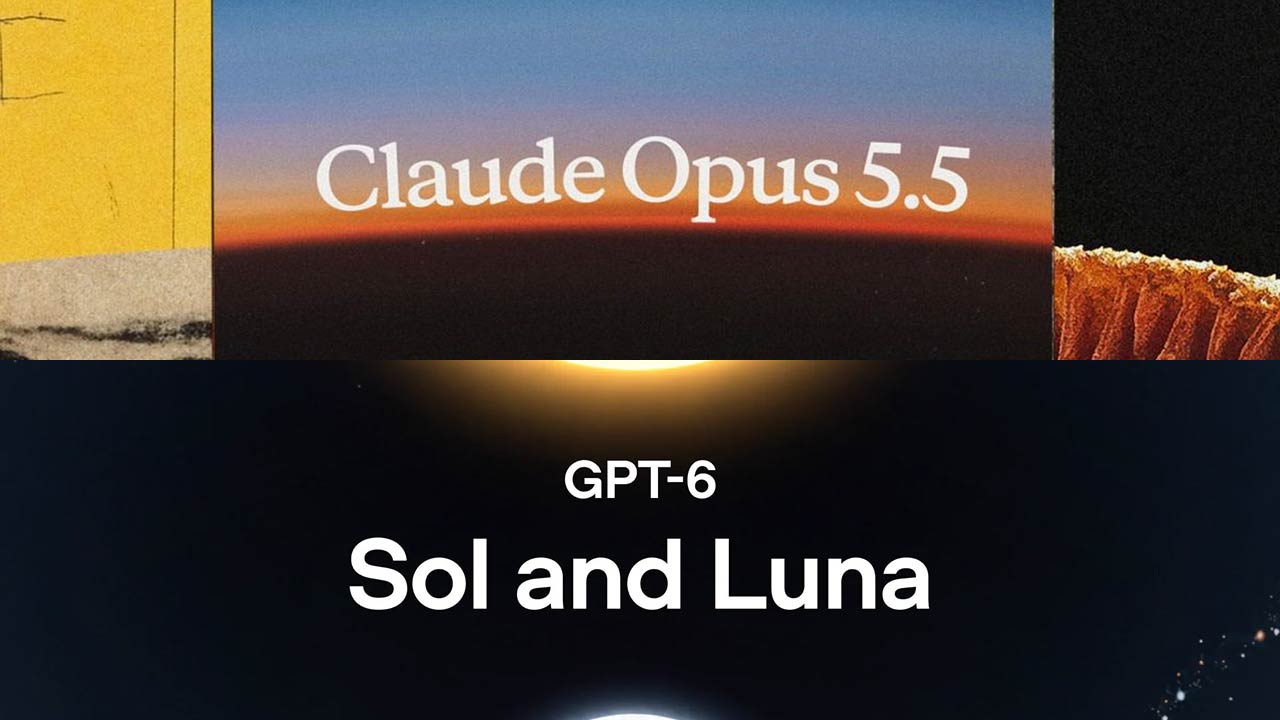
Anthropic launched Claude Opus 5.5 on Tuesday, and OpenAI released GPT-6 Sol and GPT-6 Luna roughly an hour later. Anthropic says Opus 5.5 performs at the level of its pricier Fable 5.1 on most work and costs 40% less to run than Opus 5 on typical workloads at default settings. OpenAI cut API prices for Sol and Luna by at least half versus its GPT-5.6 promotional rates. Both companies were as focused on the bill as they were on the brains.
At standard rates for prompts up to 272,000 input tokens, Opus 5.5 lists at $4 per million input tokens and $20 per million output tokens, down from $5 and $25 for Opus 5. GPT-6 Sol lists at $2 and $10 (down from $4 and $20), exactly half of Opus 5.5. GPT-6 Luna drops to $0.10 and $0.50 (from $0.20 and $1.20). Opus 5.5 and Sol tie on cache-read pricing. Anthropic says cache reads make up the majority of agentic and coding costs, and it priced them at $0.20 per million, 60% below Opus 5. OpenAI’s 90% cache discount puts Sol’s cache reads at $0.20 as well.
Neither lab’s launch chart includes the other lab’s same-day release. OpenAI says Sol at xhigh effort beat Claude Opus 5 at max effort on Zapier’s AutomationBench (33.2% to 26.9%) at 9% of the cost per task. Anthropic’s chart puts Opus 5.5 at 40.0% on the same test, just behind GPT-6 Astra at 41.4%, both at max effort. OpenAI notes that Fable 5.1 fell back to Opus 5 on about 40% of tasks, and Anthropic says its own safeguard interventions were scored as failures. Anthropic also concedes that benchmark margins have become “a less reliable guide to real-world differences.”
Tokens are easy to meter and hard to value. Anthropic is selling fewer tokens per task. OpenAI is selling cheaper tokens. A better metric is cost per completed task (inside your actual workflows).
Every company needs a Claw strategy. Do you have one?
Author’s note: This is not a sponsored post. I am the author of this article and it expresses my own opinions. I am not, nor is my company, receiving compensation for it. This work was created with the assistance of various generative AI models.
About Shelly Palmer
Shelly Palmer is the Professor of Advanced Media in Residence at Syracuse University’s S.I. Newhouse School of Public Communications and CEO of The Palmer Group, a consulting practice that helps Fortune 500 companies with AI strategy, implementation and governance, as well as technology, media and marketing. Named one of LinkedIn’s Top Voices in Technology, he is a bestselling author, covers tech and business for Fox 5’s Good Day New York, is a regular commentator on CNN, and writes the popular daily business blog Think About This. Follow @shellypalmer or visit shellypalmer.com.