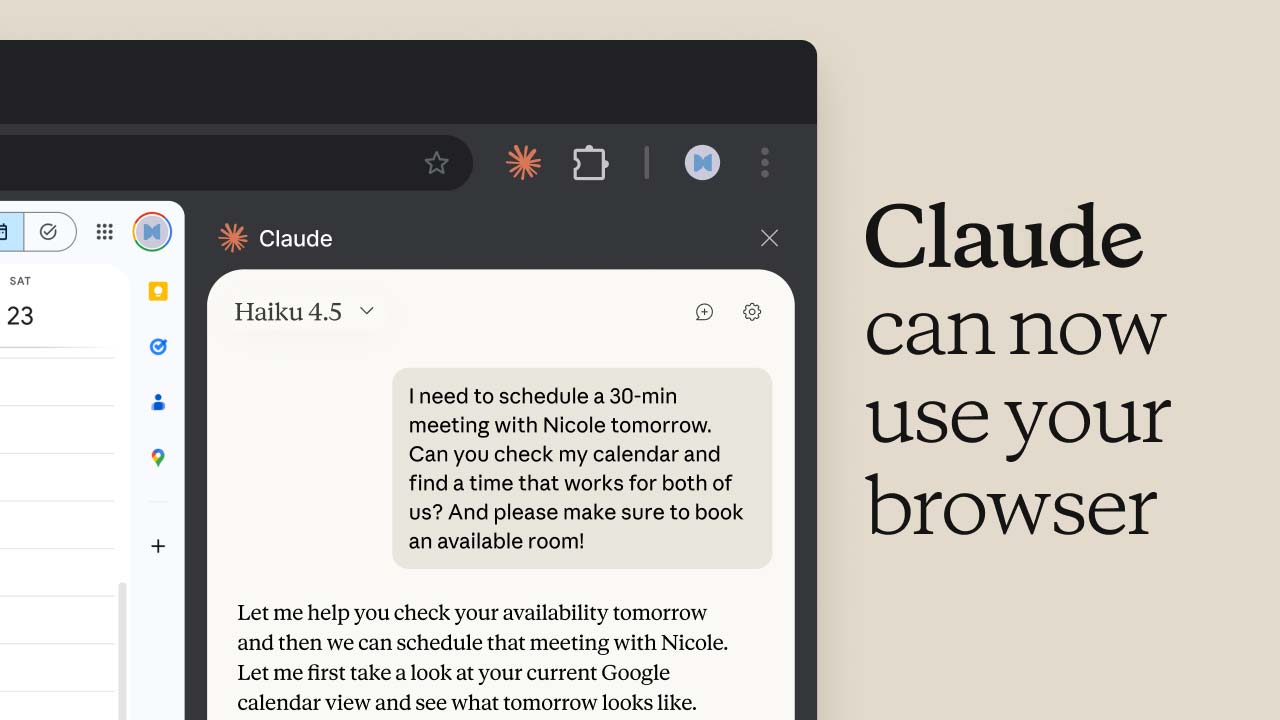
Claude lovers have another reason to rejoice: the Claude in Chrome side panel now runs as a full Claude Cowork session. The feature is live for Max and Team subscribers, rolls out to Pro plans over the coming weeks, and ships disabled by default for Enterprise, where administrators can enable it and restrict it to approved domains. As of this writing, Anthropic’s enterprise documentation states that Cowork activity is not captured in Audit Logs, the Compliance API, or Data Exports.
Until now, a session in the Chrome side panel was separate from sessions in the Claude apps, so context and conversations did not carry between them. With this update, side-panel conversations save to the user’s history and are accessible across Claude’s desktop, web, and mobile apps. Your existing skills and connectors work inside the browser for the first time with no additional setup, and a task started in a browser tab can be finished in the desktop, web, or mobile app (or the reverse) with full context intact. The extension itself can view the page a user is on and act agentically. It can click links, type text, navigate between pages, and fill out forms, etc. Anthropic also added an “automatically approve” mode in which, in the company’s words, “Claude works through a task without stopping for permission at every step.”
Browser extensions are an interesting component of the AI browser wars. Chrome is natively Gemini-powered (and Google Search itself is increasingly Gemini-powered). Microsoft retired Edge’s separate Copilot Mode this past May and folded multi-tab reasoning, Journeys, and voice and vision directly into Edge for free on desktop and mobile. OpenAI retired its standalone Atlas browser in July (it stopped working entirely on August 9) and is moving the agentic pieces into its ChatGPT Work agent, a Chrome extension, the desktop app’s in-app browser, and a cloud browser. Perplexity’s Comet has been free since October 2025 and runs on Windows, macOS, Android, and iOS.
It feels like we are on the cusp of a new paradigm. Meeting users at the point of least friction is a time-tested way to accelerate distribution and adoption, like the “Minds” that Iain M. Banks imagined in his Culture series. In the books, the great ships and orbital habitats were run by godlike Minds, while practically everything else (down to the drones) carried some level of intelligence. It’s pretty easy to imagine a world where AI is embedded everywhere in everything.
Every company needs a Claw strategy. Do you have one?
Author’s note: This is not a sponsored post. I am the author of this article and it expresses my own opinions. I am not, nor is my company, receiving compensation for it. This work was created with the assistance of various generative AI models.
About Shelly Palmer
Shelly Palmer is the Professor of Advanced Media in Residence at Syracuse University’s S.I. Newhouse School of Public Communications and CEO of The Palmer Group, a consulting practice that helps Fortune 500 companies with AI strategy, implementation and governance, as well as technology, media and marketing. Named one of LinkedIn’s Top Voices in Technology, he is a bestselling author, covers tech and business for Fox 5’s Good Day New York, is a regular commentator on CNN, and writes the popular daily business blog Think About This. Follow @shellypalmer or visit shellypalmer.com.