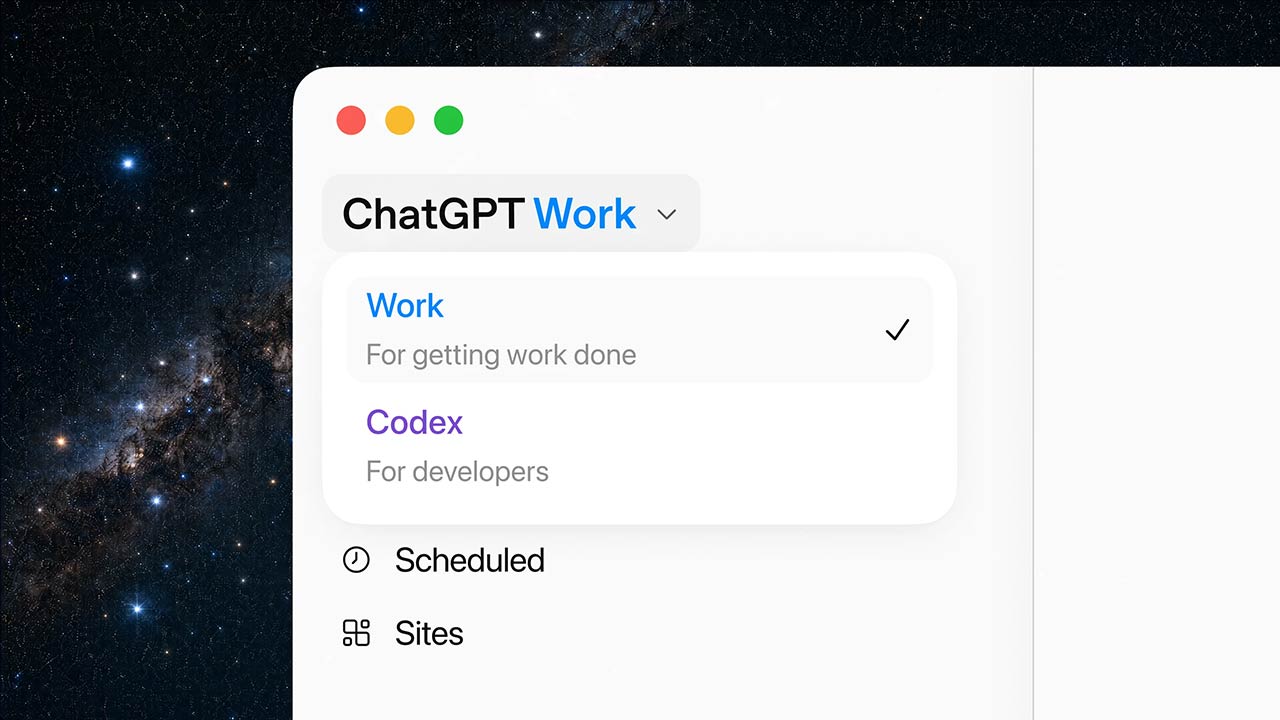
OpenAI has launched ChatGPT Work, a new desktop experience designed to do more than answer questions. It can work across your files, applications, browser tabs, and connected accounts to complete multistep assignments.
Think of it as Codex for normal people. Codex started as an AI coding agent. Developers gave it access to a software project, assigned a task, and reviewed the finished work. ChatGPT Work extends that agentic approach to general knowledge work. It can research, analyze data, create documents, build spreadsheets and presentations, operate connected applications, and complete multistep assignments. According to figures OpenAI shared with Axios, knowledge workers already account for roughly 20 percent of Codex users, and that group is growing more than three times as fast as developers.
You might ask it to research a prospective client, compare the company with its competitors, review your internal files, identify opportunities, and prepare an executive briefing. You could give it a folder of invoices and ask for a spending analysis, or have it turn meeting notes into a project plan, assign owners, draft follow-up emails, and create a presentation for the next meeting.
Importantly, these are not prompts. They are assignments.
ChatGPT Work includes integrated browsing and web interaction, supports multiple workstreams, and can handle one-time or recurring assignments. You can monitor its progress, redirect it while it works, and check on assignments from another device. It is initially available through the ChatGPT desktop app for Mac and Windows, with web and mobile access rolling out by subscription plan.
Wondering whether ChatGPT Work is similar to Claude Cowork? It is. The two products are direct competitors.
Remember: you will still need to check the work. Agentic AI can misunderstand instructions, choose bad sources, and produce beautifully formatted nonsense. That said, go have fun.
Every company needs a Claw strategy. Do you have one?
Author’s note: This is not a sponsored post. I am the author of this article and it expresses my own opinions. I am not, nor is my company, receiving compensation for it. This work was created with the assistance of various generative AI models.
About Shelly Palmer
Shelly Palmer is the Professor of Advanced Media in Residence at Syracuse University’s S.I. Newhouse School of Public Communications and CEO of The Palmer Group, a consulting practice that helps Fortune 500 companies with AI strategy, implementation and governance, as well as technology, media and marketing. Named one of LinkedIn’s Top Voices in Technology, he is a bestselling author, covers tech and business for Fox 5’s Good Day New York, is a regular commentator on CNN, and writes the popular daily business blog Think About This. Follow @shellypalmer or visit shellypalmer.com.