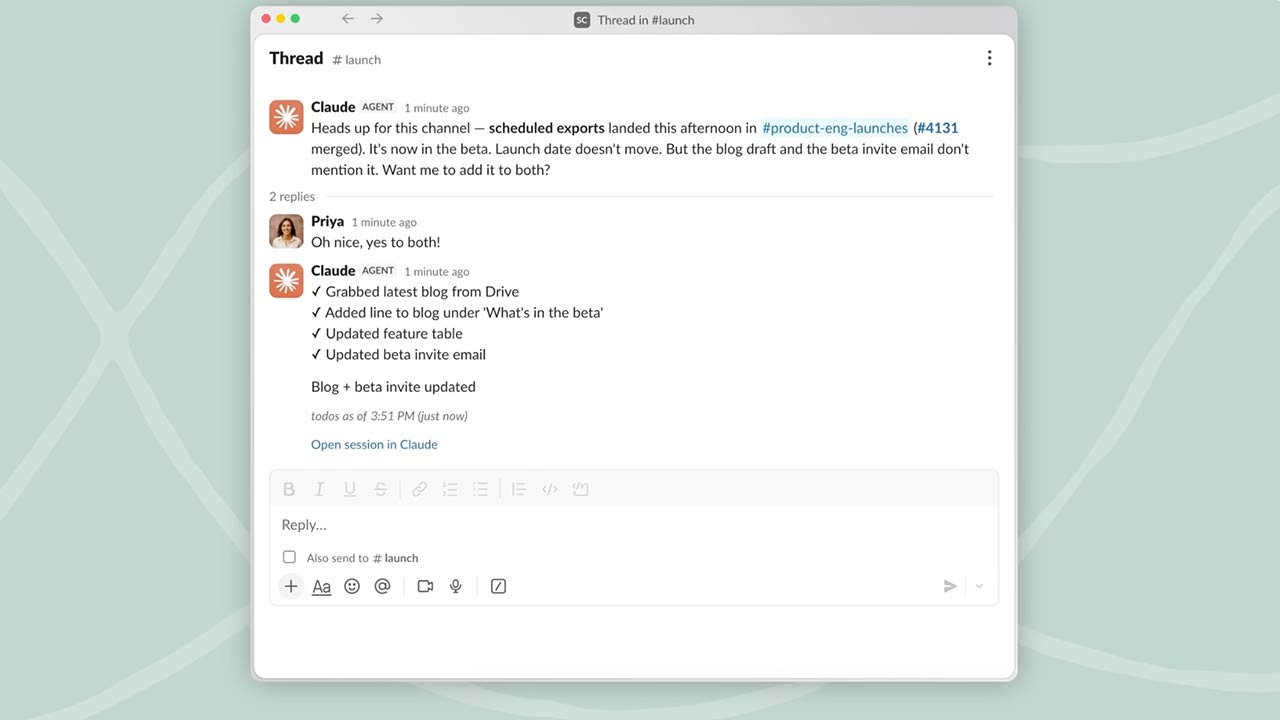
Anthropic has released Claude Tag in beta. Tag @Claude inside a Slack channel and Claude can join the workstream, follow the thread, take assignments, remember relevant channel context, and (with admin-granted access) pull from connected tools, data sources, codebases, and other approved channels. It is available now to Claude Enterprise and Team customers.
This is not just another chatbot in Slack. It is a persistent, shared Claude identity for team work. In channels, Claude acts through its own service accounts, not as the person who asked. Everyone in the channel can see the work, steer it, and pick up where someone else left off. Administrators decide which channels, tools, repositories, credentials, hosts, and data sources Claude can reach.
Access follows the channel. Public-channel memory can become workspace memory. Private-channel memory stays isolated to that private channel. Anthropic’s examples make the point clearly: Claude for one team should not leak memories, access, or context into another team’s workspace.
This is more important than it sounds because the underlying capability is persistent visibility into the collaboration layer. Every scoped channel becomes a potential input source. Over time, Claude can accumulate a working representation of how your company actually operates: where decisions get made, who owns what, what gets shipped, what gets blocked, and which informal processes matter more than the org chart.
Your Slack conversations still live in Salesforce-owned Slack, but the structured memory and context derived from them can now accumulate inside Anthropic’s product. That is a new class of enterprise asset: derivative from your operational data, invaluable to your organization, but resident in someone else’s system. Most procurement templates do not cleanly cover it yet.
Where does the persistent memory live? Who owns it? Is it exportable if you switch foundation model providers? Are Claude Tag memory files, session transcripts, routines, and audit logs included in your data export? What gets deleted, when, and by whom? What portion, if any, can flow into model improvement, safety review, feedback workflows, or future product training?
Anthropic’s commercial terms say customers retain and own outputs, and that Anthropic may not train models on Customer Content from commercial services. Good. Now get it in writing for this specific product, including memory, transcripts, audit logs, data residency, exportability, deletion, and exit rights.
Every company needs a Claw strategy. Do you have one?
Author’s note: This is not a sponsored post. I am the author of this article and it expresses my own opinions. I am not, nor is my company, receiving compensation for it. This work was created with the assistance of various generative AI models.
About Shelly Palmer
Shelly Palmer is the Professor of Advanced Media in Residence at Syracuse University’s S.I. Newhouse School of Public Communications and CEO of The Palmer Group, a consulting practice that helps Fortune 500 companies with AI strategy, implementation and governance, as well as technology, media and marketing. Named one of LinkedIn’s Top Voices in Technology, he is a bestselling author, covers tech and business for Fox 5’s Good Day New York, is a regular commentator on CNN, and writes the popular daily business blog Think About This. Follow @shellypalmer or visit shellypalmer.com.