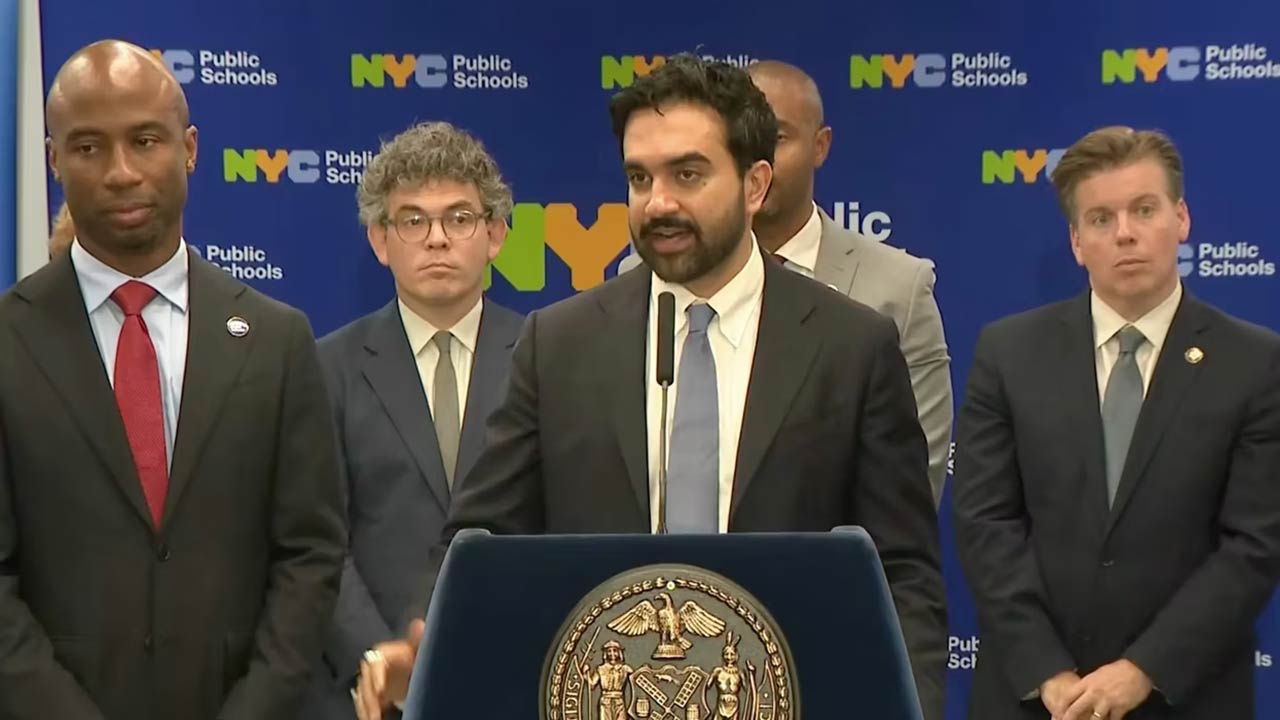
Here are the facts: On September 2, 2026, New York City Mayor Zohran Mamdani and Schools Chancellor Kamar Samuels announced a one-year moratorium on student-facing generative artificial intelligence in the city’s public schools for the 2026-27 school year. The moratorium covers children from 2-K through eighth grade and applies to all software that uses student-facing generative AI. City Hall said the policy will affect nearly 600,000 students, which is about two-thirds of the public-school system’s enrollment. New York City operates the largest public-school system in the United States.
Companion chatbots are prohibited across all grades. Teachers may continue to use AI for instructional planning and operational work when the tools meet New York City Public Schools’ safety standards. The policy provides exceptions for assistive technology used by students with disabilities, multilingual learners, and students in career-readiness programs such as computer science.
High-school students will operate under a different policy. The city will introduce five limited AI pilots (Quill, Edia, Brisk Teaching, Playlab and Intel AI-Ready Schools) for no more than 50,000 general-education high-school students, which is approximately 5% of the total public-school student body. The pilots may be offered in no more than five classes at each high school. Students will use the tools under the direct supervision of trained educators. City officials said the programs are not companion chatbots and that ChatGPT, Claude, and similar general-purpose chatbots are not being introduced into the curriculum through the pilots.
Every public high school student will be required to complete two 45-minute AI-literacy modules during the school year. The modules will cover what AI is and is not, as well as bias, risks, ethics, careers, and future skills. Students participating in the pilots and career programs will receive longer and more detailed AI-literacy instruction.
The same announcement established a new screen-time policy. Students in second grade and below will have restricted one-to-one screen time. The city recommends a daily cap of 30 minutes for students in grades three through five and 45 minutes for students in grades six through eight.
United Federation of Teachers president Michael Mulgrew praised the screen-time limits and said the AI policy left unanswered questions, including how the Education Department would require stronger safeguards from vendors. Fairplay executive director Josh Golin said he wanted a longer moratorium and more time between the announcement and the opening of school. He said one year was not enough time to evaluate the technology.
New York City is not alone. The Los Angeles Unified School District, the country’s second-largest school district, is temporarily blocking generative AI tools on student devices in every grade while it develops a student AI policy. In June 2026, Los Angeles eliminated school-issued devices for its youngest students, set screen-time limits for all grades, and blocked YouTube and other social-media sites during the school day. At least 37 states have issued official AI guidance for schools. There is no single national definition of AI literacy and no national consensus on how schools should teach it.
On a personal note: AI is not going away. It is the de facto toolset for this generation. You can read this one-year moratorium as a “good thing” because all the tests and committees and programs sound like good policy, but I’m reading this as the education-industrial-complex doing everything it can to preserve the status quo.
The general education system (from middle school through college) is badly broken and insanely out of date. We need to help the next generation prepare for the future, not preserve a system that was built for ancient times.
Every company needs a Claw strategy. Do you have one?
Author’s note: This is not a sponsored post. I am the author of this article and it expresses my own opinions. I am not, nor is my company, receiving compensation for it. This work was created with the assistance of various generative AI models.
About Shelly Palmer
Shelly Palmer is the Professor of Advanced Media in Residence at Syracuse University’s S.I. Newhouse School of Public Communications and CEO of The Palmer Group, a consulting practice that helps Fortune 500 companies with AI strategy, implementation and governance, as well as technology, media and marketing. Named one of LinkedIn’s Top Voices in Technology, he is a bestselling author, covers tech and business for Fox 5’s Good Day New York, is a regular commentator on CNN, and writes the popular daily business blog Think About This. Follow @shellypalmer or visit shellypalmer.com.