On July 16, Moonshot AI released Kimi K3, a Chinese open-weight model that reached the top tier of AI performance at a fraction of the cost of U.S. closed models. Its weights are now public; anyone can download them.
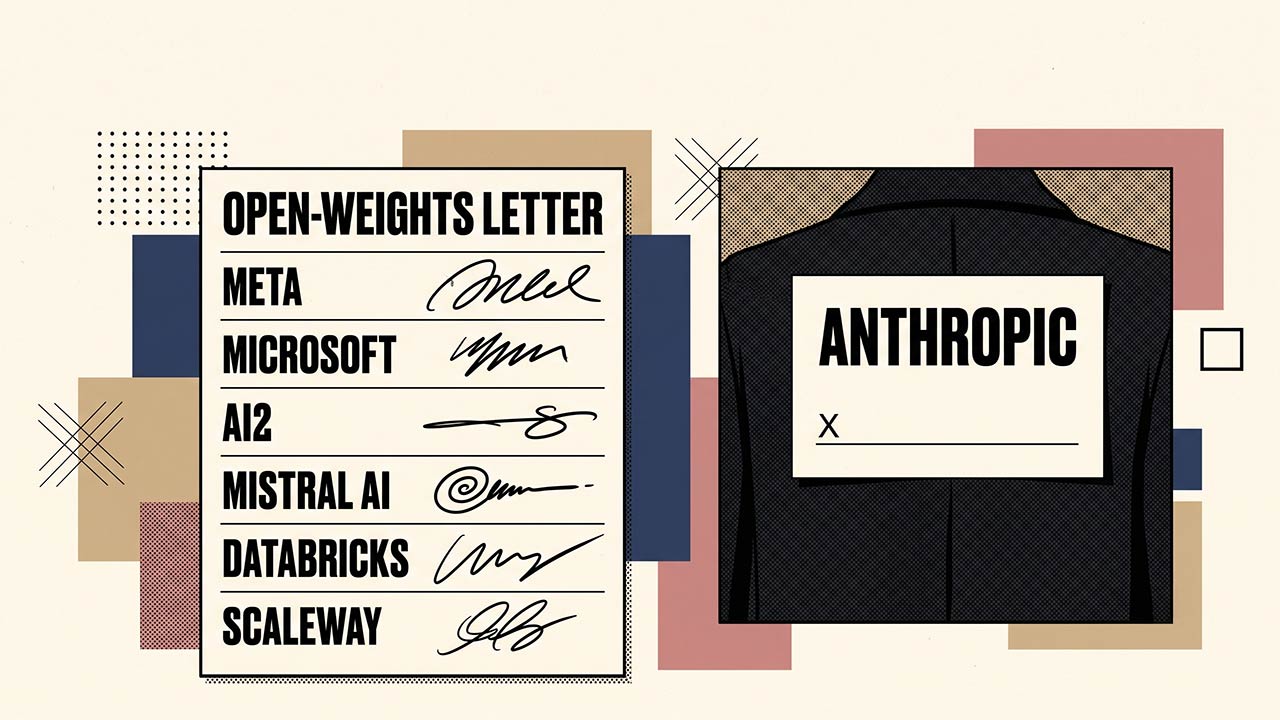
On July 24, Nvidia CEO Jensen Huang wrote a letter called “Open Weights and American AI Leadership.” It urged Washington not to restrict downloadable models. It opened with 25 signatories, which doubled to about 50 over the weekend. OpenAI and Google signed after first abstaining. Anthropic and Amazon did not.
On July 27, Dario Amodei published Anthropic’s position. He wrote that Anthropic “has never advocated for a ban on open-weights models” and called safe open models “a public good.” Instead of a ban, he asked for three measures: tighter export controls on advanced chips, a crackdown on “industrial-scale distillation,” and mandatory safety testing for capable models. Critics, including former White House AI czar David Sacks, say Anthropic uses safety to protect its business.
Two of the three leading closed-model labs signed. One did not. Amodei asked for chokepoints and said he never asked for a ban. Four questions remain open.
- Do the two sides even disagree? Amodei asked for chokepoints. The letter opposes restrictions on open weights. Do the signatories oppose safety testing and a distillation crackdown, or a ban nobody proposed?
- Does any policy reach the model? Kimi K3’s weights are already public. Amodei himself says a ban will not stop bad actors. What does any policy do about a model already downloaded worldwide?
- Who defines “industrial-scale distillation”? The letter calls distillation legitimate. Where is the line, and does any definition spare the methods US companies use themselves?
- Is there an industry position at all, or just individual companies reaching their own calls on the same facts?
As complicated and confusing as the world is right now (wars, the economy, climate issues, political division), how we handle AI has got to be near the top of the agenda. Please take the time to learn about this and make your opinions known.
Every company needs a Claw strategy. Do you have one?
Author’s note: This is not a sponsored post. I am the author of this article and it expresses my own opinions. I am not, nor is my company, receiving compensation for it. This work was created with the assistance of various generative AI models.
About Shelly Palmer
Shelly Palmer is the Professor of Advanced Media in Residence at Syracuse University’s S.I. Newhouse School of Public Communications and CEO of The Palmer Group, a consulting practice that helps Fortune 500 companies with AI strategy, implementation and governance, as well as technology, media and marketing. Named one of LinkedIn’s Top Voices in Technology, he is a bestselling author, covers tech and business for Fox 5’s Good Day New York, is a regular commentator on CNN, and writes the popular daily business blog Think About This. Follow @shellypalmer or visit shellypalmer.com.