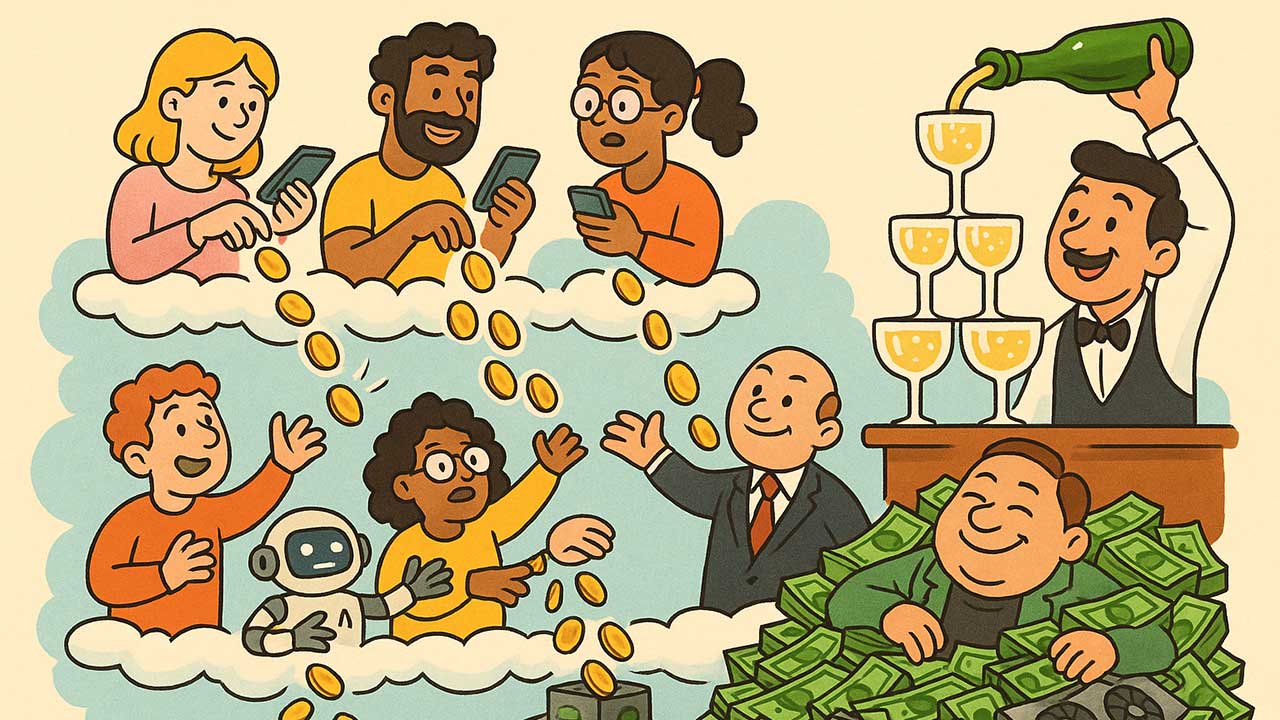
There’s a meme that’s been circulating around the interweb this week. It goes something like this:
Users pay $200/year for an AI app like Cursor or Lovable.
Cursor pays $500 to OpenAI.
OpenAI pays $1,000 to AWS or Microsoft.
AWS then spends $10,000 on NVIDIA GPUs.
And the gap is covered by venture capital.
This scheme works only as long as VC money flows like free champagne. But what happens when the bar tab comes due?
Three possible futures:
Price hikes – users pay $1,000+/year
Cost collapse – cheaper GPUs, efficient models, decentralized compute.
Implosion – AI apps and LLMs vanish in a mass shakeout.
And the winners in every scenario will be the same: NVIDIA, Microsoft, Amazon, Google.
I like the simplicity of this meme, but there are far more than three probable futures. Here are five more:
- Open-Source Upsurge – Low-cost, open-source models become good enough for most tasks. Local LLMs run on edge devices, startups fork cheap models instead of paying API fees, and the moat around proprietary models erodes. Winners: Hugging Face, Stability AI, open-source contributors, chipmakers focused on edge inference (e.g., Qualcomm).
- Platform Consolidation – Only the hyperscalers survive the margin squeeze. They absorb startups or integrate their features natively into their ecosystems. Every “AI app” becomes just another tab in Microsoft 365, Google Workspace, or Amazon Q. Winners: Microsoft, Google, Amazon. Losers: Vertical SaaS AI startups.
- Regulatory Squeeze – Governments impose transparency, audit, copyright, or model licensing rules that drastically increase operating costs for small AI firms. This creates artificial moats for incumbents and freezes experimentation. Winners: Big Tech with legal departments. Losers: AI hobbyists, tinkerers, and small startups.
- Consumer AI Burnout – The novelty wears off. Casual users abandon AI tools that don’t deliver meaningful ROI. Daily usage drops. The market contracts to serious productivity tools for professionals and enterprise workflows. Winners: Enterprise AI platforms, embedded copilots. Losers: Lifestyle and gimmick AI apps.
- Agentic Supercycle – Autonomous agents (composable, goal-seeking systems) mature faster than expected. They take actions, manage workflows, and deliver results. This creates new platform dynamics and API economies. Winners: Agent orchestration layers, secure data integration platforms, trusted agent registries. Losers: Anything designed for human-in-the-loop microtasks.
These are just a few thought starters, but this meme raises the question, “What do you believe?” This should inspire you to craft your own investible theses based on your vision for the future. It’s a worthwhile exercise.
Author’s note: This is not a sponsored post. I am the author of this article and it expresses my own opinions. I am not, nor is my company, receiving compensation for it. This work was created with the assistance of various generative AI models.
About Shelly Palmer
Shelly Palmer is the Professor of Advanced Media in Residence at Syracuse University’s S.I. Newhouse School of Public Communications and CEO of The Palmer Group, a consulting practice that helps Fortune 500 companies with technology, media and marketing. Named LinkedIn’s “Top Voice in Technology,” he covers tech and business for Good Day New York, is a regular commentator on CNN and writes a popular daily business blog. He's a bestselling author, and the creator of the popular, free online course, Generative AI for Execs. Follow @shellypalmer or visit shellypalmer.com.