Cultural Debt is the sum of every unresolved habit, unexamined process, and unspoken assumption an organization carries forward. It is sustained by the inertia of the exceptionally powerful, “that’s the way we do it.” Add a dash of, “not invented here,” then garnish with the growing fear of AI, and you’ve got a recipe for a huge leadership challenge.
As we start to deploy enterprise AI, one thing is becoming clear: three foundational business artifacts must be reimagined from first principles: the org chart, the job description, and the performance review. Let’s explore.
First, two quick definitions for this article. Workflows are systems in which LLMs and tools are orchestrated along predefined code paths. Agents are systems in which LLMs dynamically direct their own processes and tool usage, controlling how they accomplish tasks. For more on this see, How Anthropic Thinks About Agents, Workflows, and Tasks.
New Responsibilities
Your executives now have three jobs: the job you hired them to do, the job of creating new workflows and agents, and the job of maintaining the existing workflows and agents. Maintenance is real work. Models change, prompts rot, integrations break, and every workflow needs an eval (a grading rubric that tells you whether the agent’s output meets your standards) that someone has to keep current.
Would you allow 20 percent of a senior executive’s day to be spent on maintaining workflows and agents, 30 percent of their day creating new workflows and agents, and 50 percent of their day doing what they were originally hired (and compensated) to do?
Members of Fortune 500 executive leadership teams are literally the best in the world at what they do and their compensation reflects the value they create. Your C_O earns $5 million a year. Should you spend $1 million of their time maintaining workflows and agents? Is $1.5 million the right amount of their time to spend on creating new workflows and agents? Current leaders are experts at leading people. You don’t lead agents, you manage them.
No problem, you say. Just push these functions down to a lower management level.
That won’t work. All you’re doing is creating an additional human bottleneck in a process that should be fully automated. Every level of human bureaucracy you add just slows the process down. That may be fine for today. But, considering the speed of AI innovation, it is not sustainable.
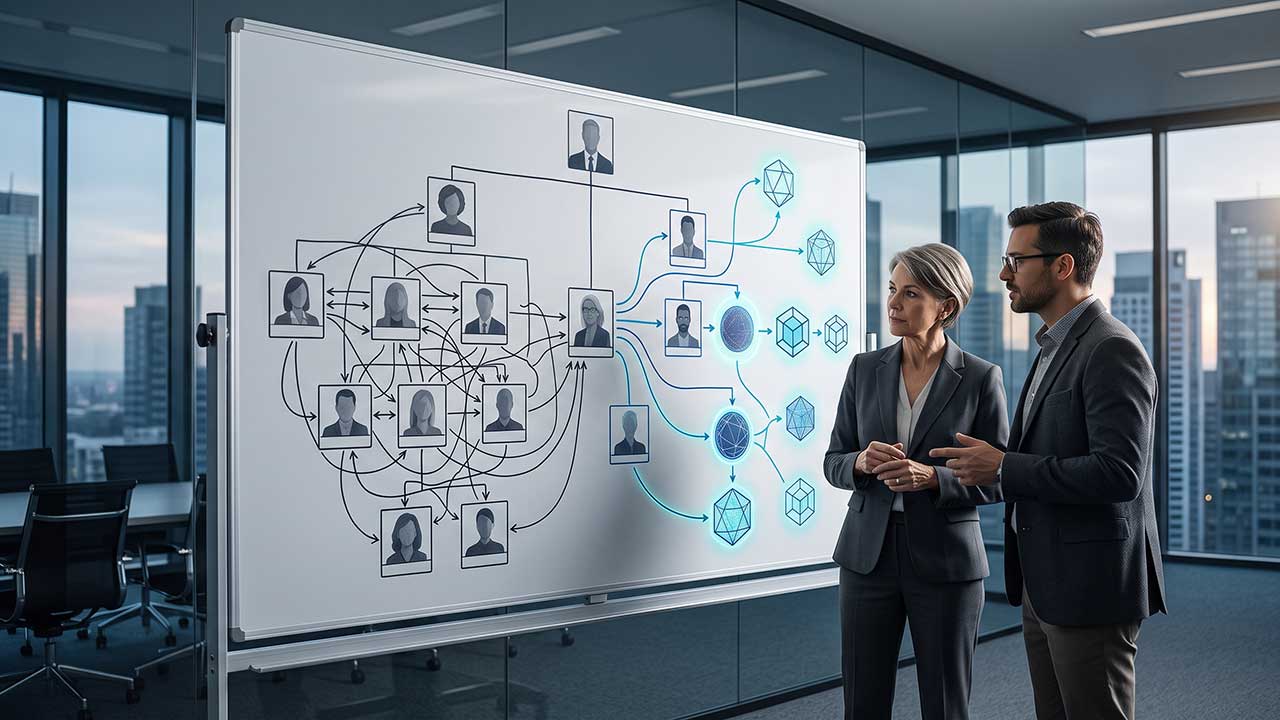
We are going to need new ways to organize human/ai coworker pairs. This will start with a revised job description and a revised org chart.
The Human/AI Coworker Org Chart
There are two distinctly different modes of AI use at enterprise scale. First is a pick list of AI tools that your team members just use. They prompt their way through their projects and may even submit an eval once in a while, but improving the workflows and agents are someone else’s responsibility. Then there are the people actually responsible for creating and maintaining workflows and agents. The line between these two modes is fading fast, and in short order, this will be a distinction without a difference.
So, how will you structure a group? How about a dedicated pair: one executive (subject matter expert), one engineer, building together. It produces the fastest results. It’s great for pilots, but it doesn’t scale. Or, invent the role of shared AI engineer, one technical partner supporting three or four executives. This is the structure we are using for most of our clients right now. It concentrates scarce talent, forces prioritization, spreads patterns across functions, and creates a natural teacher. In more AI-mature environments, we’re seeing executives build their own workflows on a governed platform, with engineering centralized in an AI operations group that owns access control, agent identity, lifecycle management, and the approved-model policy.
There are numerous variations on these themes and there’s no “right way” to do it. But evolving maximally adaptable human/AI organizations is the focus of almost every whiteboard session I have with my clients right now.
The New Job Description
Traditional job descriptions define the tasks a person performs, the people they supervise, and the authority they possess. An AI-era job description must also define the outcomes the person owns, the AI systems they are expected to use, and the workflows and agents for which they are accountable.
It should specify who can create or modify an agent, who maintains its instructions and integrations, who owns its evals, which decisions require human approval, and what happens when the system fails.
The New Performance Review
If an executive can command a digital staff capable of completing thousands of tasks, measuring effort, hours, or conventional output becomes less meaningful. Performance must be evaluated against business outcomes, the quality and reliability of the systems the executive oversees, and the executive’s ability to improve those systems over time.
Did the executive increase productivity without compromising quality? Did they reduce failure rates, improve eval performance, eliminate unnecessary processes, and use human judgment at the right moments? Did they document risks and remain accountable for the actions of their agents?
The goal is not to reward executives for deploying the most AI. It is to reward them for creating the most value with AI while managing the associated risk.
New Artifacts
The org charts, job descriptions, and performance reviews you have are artifacts of an era when human beings were required for virtually all cognitive work. That is no longer true. It is time to decide what you expect from a direct report who oversees a mixed staff of people and software, how you will evaluate them, and how you will build an organization that catches cultural debt before it accidentally automates it.
Author’s note: This is not a sponsored post. I am the author of this article and it expresses my own opinions. I am not, nor is my company, receiving compensation for it. This work was created with the assistance of various generative AI models.
About Shelly Palmer
Shelly Palmer is the Professor of Advanced Media in Residence at Syracuse University’s S.I. Newhouse School of Public Communications and CEO of The Palmer Group, a consulting practice that helps Fortune 500 companies with AI strategy, implementation and governance, as well as technology, media and marketing. Named one of LinkedIn’s Top Voices in Technology, he is a bestselling author, covers tech and business for Fox 5’s Good Day New York, is a regular commentator on CNN, and writes the popular daily business blog Think About This. Follow @shellypalmer or visit shellypalmer.com.