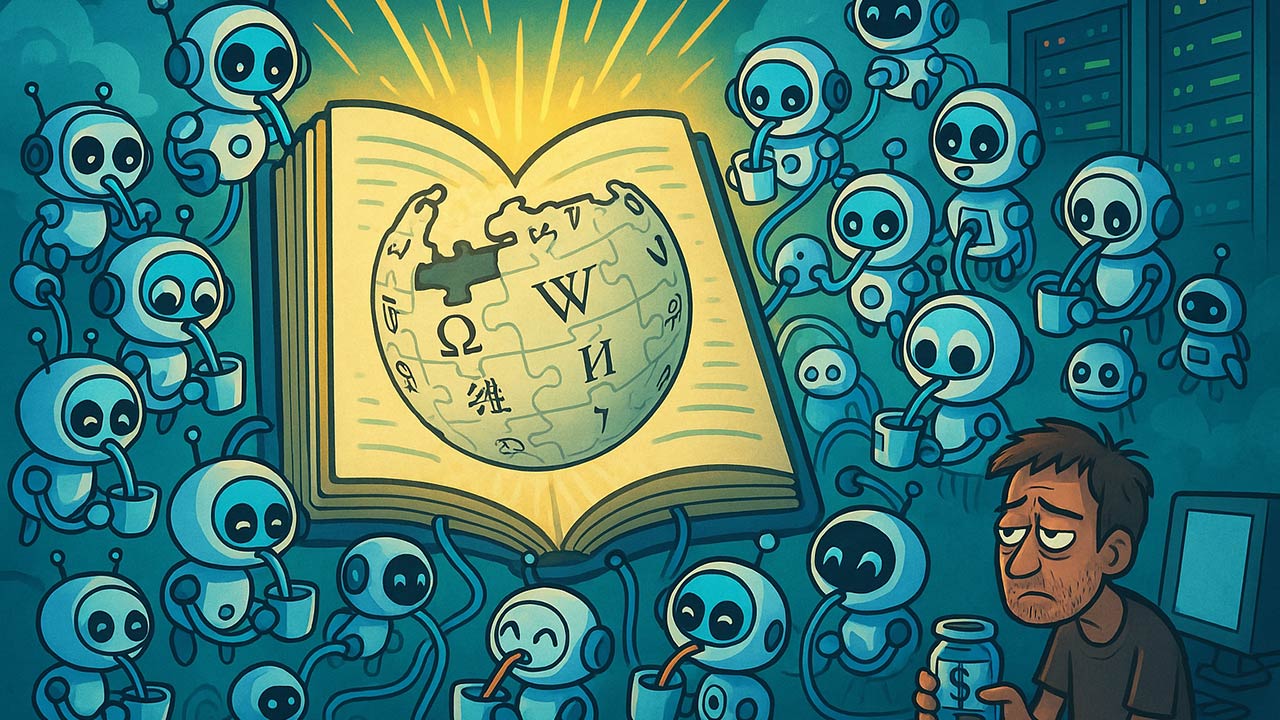
Wikipedia just told the AI industry to stop scraping and start subscribing. In a blog post Monday, the Wikimedia Foundation urged AI developers to access its content through Wikimedia Enterprise, a paid API that supports the site’s nonprofit mission. The message was polite but clear: attribution matters, and free-riding doesn’t.
Bots pretending to be human have been hitting Wikipedia’s servers for months. The organization says its traffic spike in May and June came from AI models harvesting data, not from readers. Human page views fell eight percent year over year; fewer visits mean fewer editors and fewer donations.
The bigger problem isn’t scraping. It’s relevance. Wikipedia was built for people who needed everything in one place, but AI doesn’t need everything in one place to find what matters. Crowd-sourced knowledge made sense when search was manual. It doesn’t make sense when models can pull, verify, and rewrite facts across thousands of sources in seconds.
When Wikipedia is right, it’s very right. When it’s wrong, it’s very wrong. That’s not hallucination. It’s vandalism, bias, or bad data. AI systems that rely on it inherit those errors.
Wikipedia is asking AI to fund its future, but the truth may be harder to face. The crowd built the modern web. The machines are building what comes next.
Author’s note: This is not a sponsored post. I am the author of this article and it expresses my own opinions. I am not, nor is my company, receiving compensation for it. This work was created with the assistance of various generative AI models.
About Shelly Palmer
Shelly Palmer is the Professor of Advanced Media in Residence at Syracuse University’s S.I. Newhouse School of Public Communications and CEO of The Palmer Group, a consulting practice that helps Fortune 500 companies with AI strategy, implementation and governance, as well as technology, media and marketing. Named one of LinkedIn’s Top Voices in Technology, he is a bestselling author, covers tech and business for Fox 5’s Good Day New York, is a regular commentator on CNN, and writes the popular daily business blog Think About This. Follow @shellypalmer or visit shellypalmer.com.