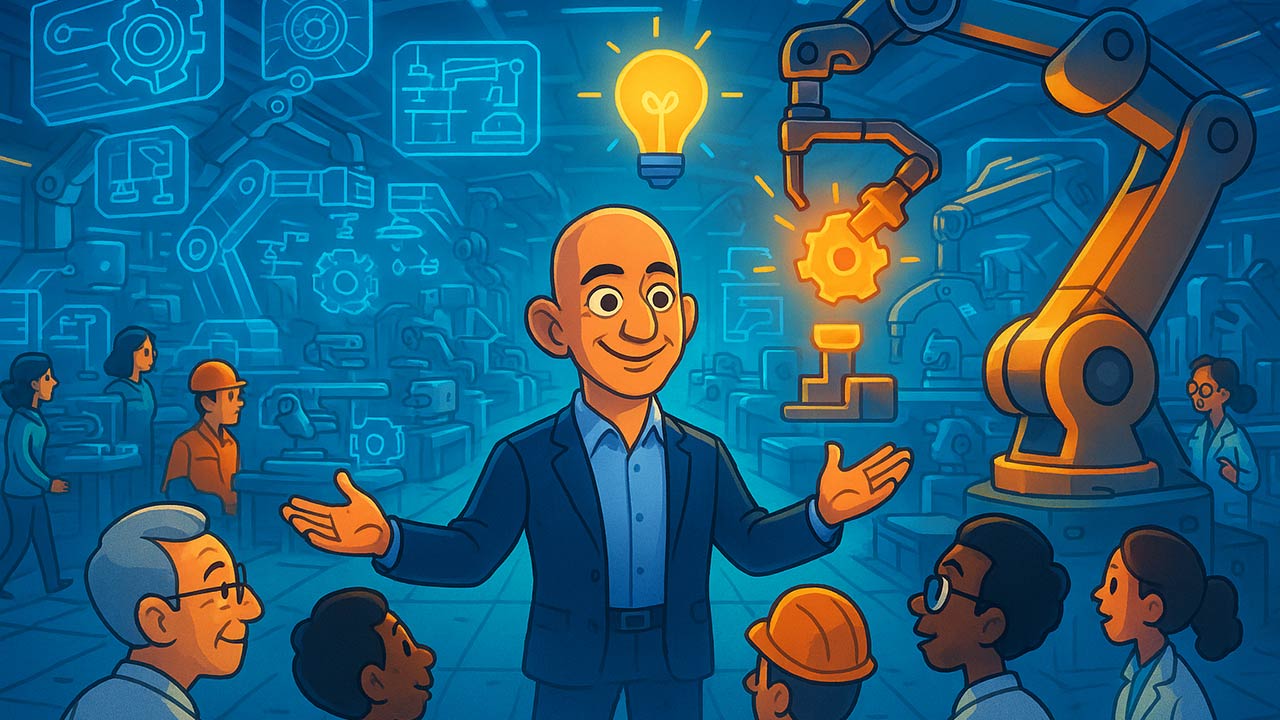
Project Prometheus is a new AI company co-led by Jeff Bezos and physicist Vik Bajaj. According to the New York Times, the company raised about $6.2 billion before launch. It focuses on physical AI, which refers to models and systems that understand, simulate, and optimize real-world processes in engineering and manufacturing. Prometheus treats physical systems as core surfaces for AI-driven design, automation, and optimization. This is Jeff Bezos’s first operational role since stepping down as Amazon’s CEO back in 2021.
The early team is reported to include talent from OpenAI, DeepMind, and Meta AI. As you know, talent migration usually precedes market movement. This is where the cool kids think the big money is going to come from. They’re probably right. The future will depend on AI that models, simulates, and optimizes physical systems within the limits of real-world data and physics. Practical gains depend on simulation fidelity, sensor noise, and the compute required to run large-scale models at useful speeds. These tools will influence timelines, costs, and throughput for any manufacturer that can put them to work, and the real test is whether they can shorten the distance between an idea and a finished product.
Physical AI is a relatively crowded space. Figure is training large models for humanoid robots in commercial settings. Tesla is building Optimus for factory and logistics tasks. Covariant is applying foundation models to robotic manipulation. NVIDIA is expanding its Omniverse platform for physics-based simulation and industrial digital twins. Siemens and Dassault are integrating AI into engineering workflows through model-based design tools. And, if you paid close attention to OpenAI’s Sora 2 announcement, it was all about getting the real world physics right.
Software may still be eating the world, but hardware’s time is just around the corner. Physical AI is about building things that work better, faster, and at scale. Can AI shorten the distance between an idea and a finished product? Prometheus is structured to find out.
Author’s note: This is not a sponsored post. I am the author of this article and it expresses my own opinions. I am not, nor is my company, receiving compensation for it. This work was created with the assistance of various generative AI models.
About Shelly Palmer
Shelly Palmer is the Professor of Advanced Media in Residence at Syracuse University’s S.I. Newhouse School of Public Communications and CEO of The Palmer Group, a consulting practice that helps Fortune 500 companies with AI strategy, implementation and governance, as well as technology, media and marketing. Named one of LinkedIn’s Top Voices in Technology, he is a bestselling author, covers tech and business for Fox 5’s Good Day New York, is a regular commentator on CNN, and writes the popular daily business blog Think About This. Follow @shellypalmer or visit shellypalmer.com.