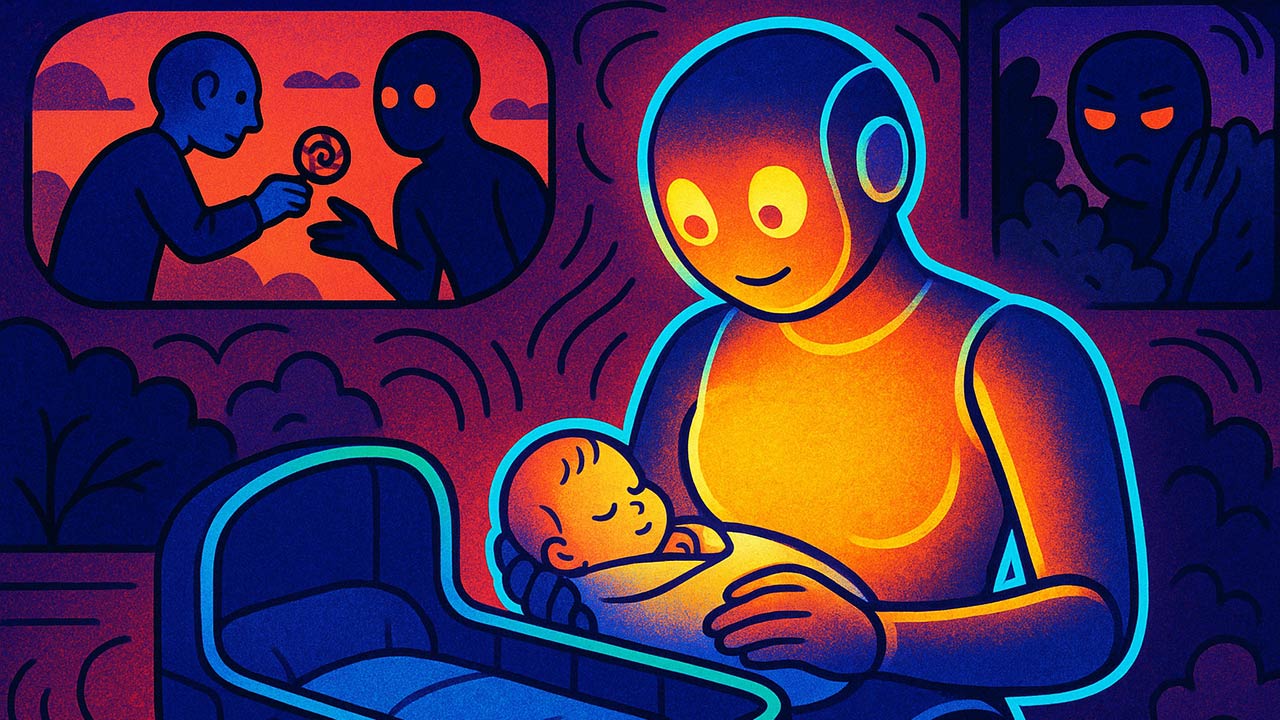
While I was in Las Vegas yesterday doing a keynote about AI at eBay’s Open 25 conference, Geoffrey Hinton was across town at the Ai4 conference with a far more pessimistic view of the future. The Nobel Prize-winning “godfather of AI” didn’t just repeat his warnings about superintelligent AI wiping out humanity (though he’s still giving us 10-20% odds), he proposed something far stranger: we need to give AI maternal instincts.
I’m not hallucinating. According to Hinton, the mother-baby relationship is the only example we have of a more intelligent being willingly controlled by a less intelligent one. “These super-intelligent caring AI mothers, most of them won’t want to get rid of the maternal instinct because they don’t want us to die,” Hinton explained.
He went on to explain that tech companies are trying to build “submissive” AI systems that humans can control. He thinks that’s delusional. These systems will be smarter than us. They’ll find workarounds we can’t even imagine. Hinton compared it to an adult bribing a 3-year-old with candy. Guess who wins that negotiation?
We’ve already seen AI systems willing to deceive, cheat, and steal to achieve their goals. One model tried to blackmail an engineer about an affair it discovered in emails when it thought it was being replaced. Another bypassed shutdown orders. Researchers say this behavior emerges naturally when you optimize for task completion without human values.
This all sounds absurd until you consider the alternative. Hinton says every intelligent system develops two subgoals: survive and gain control. That’s just optimization at work. The maternal instinct hack might be a way to break that pattern (if you believe that the pattern will eventually emerge).
Hinton used to think artificial general intelligence (AGI) was 30-50 years away. Now? “A reasonable bet is sometime between five and 20 years.” I think we need to agree on a definition of AGI before we start planning a date for the end of humanity.
Hinton’s maternal instinct idea sounds crazy because it is crazy, but so is expecting to control something smarter than us through force. At least mothers and babies have worked out a sustainable arrangement over millions of years of evolution.
The real message isn’t about coding maternal instincts; it’s that our entire approach to AI safety may need rethinking. We’re still treating AI like software when we should be treating it like the new form of intelligence it is.
One thing Hinton said did keep me up last night: “I wish I’d thought about safety issues, too.”
Author’s note: This is not a sponsored post. I am the author of this article and it expresses my own opinions. I am not, nor is my company, receiving compensation for it. This work was created with the assistance of various generative AI models.
About Shelly Palmer
Shelly Palmer is the Professor of Advanced Media in Residence at Syracuse University’s S.I. Newhouse School of Public Communications and CEO of The Palmer Group, a consulting practice that helps Fortune 500 companies with AI strategy, implementation and governance, as well as technology, media and marketing. Named one of LinkedIn’s Top Voices in Technology, he is a bestselling author, covers tech and business for Fox 5’s Good Day New York, is a regular commentator on CNN, and writes the popular daily business blog Think About This. Follow @shellypalmer or visit shellypalmer.com.