In the race to harness AI’s transformative potential, success stories are emerging across the Fortune 500. Yet even the most well-managed organizations face a common challenge: how to align numerous AI initiatives toward a cohesive strategic vision.
When your organization has dozens or even hundreds of AI projects running simultaneously, tactical excellence alone isn’t enough. Each team naturally optimizes for their specific objectives—whether that’s customer experience, operational efficiency, or product innovation. What’s often missing is a clear North Star that unifies these efforts.
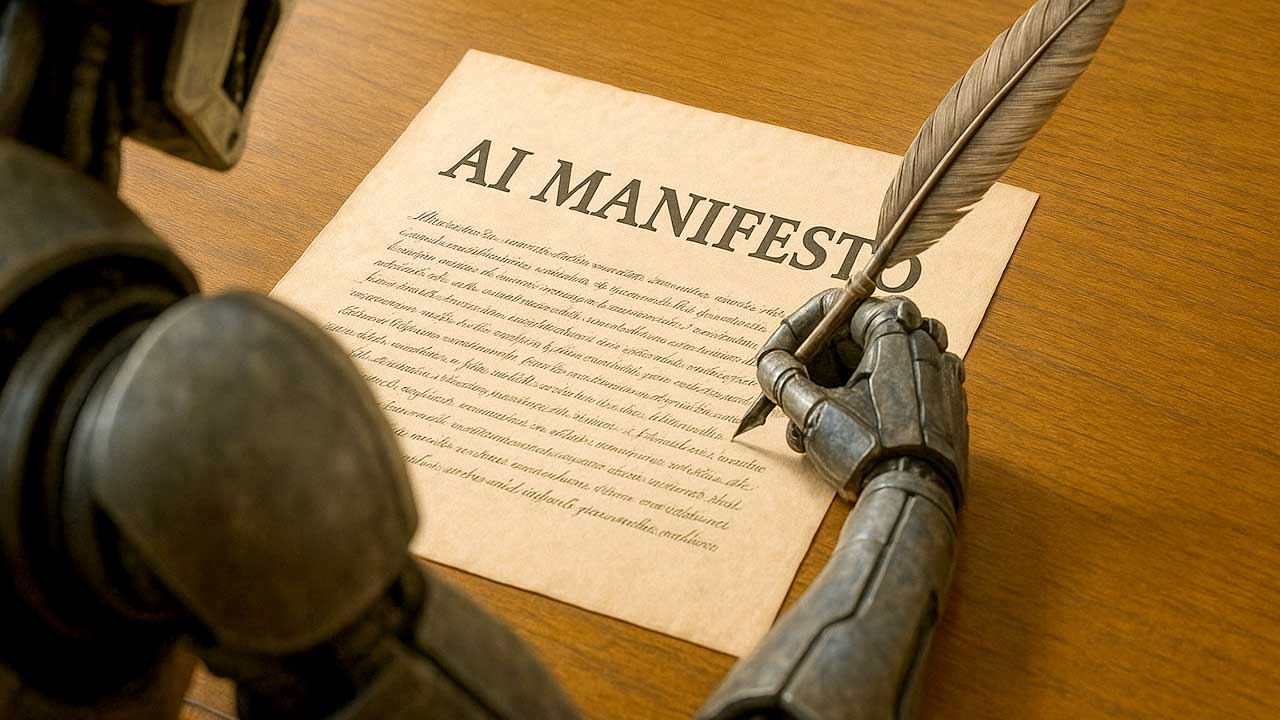
This is where a Corporate AI Governance Manifesto becomes invaluable. Not as a restrictive policy document, but as a strategic framework that:
- Articulates your organization’s unique AI philosophy and priorities
- Provides decision-making principles for teams across the enterprise
- Ensures consistent approaches to ethics, risk, and compliance
- Accelerates implementation by reducing case-by-case deliberations
For organizations ready to move from scattered AI experiments to enterprise-wide transformation, a well-crafted manifesto offers the strategic alignment needed to maximize return on AI investments while managing emerging risks.
Why Traditional Governance Falls Short
Your existing technology governance mechanisms weren’t designed for AI. They focus on familiar concepts like uptime, security, compliance, and ROI calculations based on predictable outcomes. AI introduces entirely new dimensions:
- Models that evolve and make decisions in ways that aren’t fully transparent
- Outputs that can appear authoritative yet be entirely fabricated
- Capabilities that improve (or degrade) without explicit programming
- Profound ethical and societal implications beyond technical considerations
- Cultural transformation that traditional change management wasn’t built for
Most importantly, AI isn’t just another technology implementation – it’s an organizational transformation that touches every function, role, and business process.
The Cost of Governance Failure
Without principled AI governance, the consequences are severe and increasingly likely:
- Shadow AI: Teams deploy unvetted models and unapproved tools to bypass bureaucratic roadblocks
- Talent Exodus: Your best people leave for organizations where they can meaningfully engage with AI
- Competitive Disadvantage: While you debate policies, competitors outmaneuver you with AI-augmented capabilities
- Ballooning Costs: Duplicative efforts and incompatible systems as different groups implement AI in silos
- Legal/Reputational Damage: The inevitable mishaps with biased outputs, privacy violations, or copyright infringements
- Lost Focus: Without clear priorities, you chase every AI use case rather than focusing on transformative applications
Why a Manifesto, Not Just a Policy
Your organization doesn’t need another hundred-page policy document that gathers digital dust. You need a living declaration of principles – a manifesto – that energizes and aligns the organization while providing practical guidance.
A policy tells people what they can’t do. A manifesto inspires them with what they should do.
How to Create Your AI Governance Manifesto
A powerful AI Governance Manifesto contains five essential components:
1. Strategic Intent
Begin with a clear statement of why your organization is embracing AI. This isn’t about technology – it’s about your business purpose:
“We deploy AI to extend human creativity, accelerate innovation, and eliminate drudgery – allowing our teams to focus on the uniquely human elements of our customer relationships.”
Contrast this with a more cautious organization:
“We selectively implement AI where it demonstrably improves quality and consistency, maintaining human oversight of all consequential decisions to protect our reputation for precision and care.”
Neither is inherently better, but they reflect fundamentally different strategic approaches.
2. First Principles
The heart of your manifesto is a set of 5-7 foundational principles – the non-negotiable values that guide all implementation decisions. For example:
- Augmentation, Not Replacement: We deploy AI to enhance human capabilities, not substitute for human judgment.
- Validated Outputs: We implement verification mechanisms for all AI outputs that impact customers or strategic decisions.
- Data Sovereignty: We maintain ownership and control of all data used to train our AI systems.
- Transparent Provenance: We clearly attribute and distinguish AI-generated content from human-created content.
- Universal Access: We democratize AI tools across our organization rather than restricting them to specialized teams.
- Continuous Learning: We treat all AI implementations as perpetual beta, requiring ongoing monitoring and improvement.
These principles should be specific enough to guide real decisions but broad enough to apply across diverse use cases.
3. Accountability Framework
Your manifesto must clarify who’s responsible for what:
- Board Level: Overall risk appetite and compliance oversight
- Executive Level: Strategic alignment and resource allocation
- Cross-Functional Committee: Use case approval and ethics governance
- Business Unit Leaders: Implementation within defined guardrails
- Individual Contributors: Responsible use and feedback
Without clear accountability, your principles remain aspirational rather than operational.
4. Decision Rights
For each category of AI deployment, clarify:
- Who has authority to approve
- Required documentation and risk assessment
- Success metrics and monitoring requirements
- Testing and validation protocols
- Review and renewal timelines
This transforms abstract principles into practical guidance for teams making real-world implementation decisions.
5. Learning Mechanisms
Finally, your manifesto should establish how the organization will evolve its approach:
- Regular review cycles for the manifesto itself
- Feedback channels from all stakeholders
- External benchmarking against industry practices
- Incident response and root cause analysis
- Knowledge sharing across business units
Operationalizing Your AI Governance Manifesto
A manifesto on its own changes nothing. Here’s how to make it real:
Executive Modeling
Your C-Suite must visibly embody the principles. When the CEO rejects an AI implementation that promises substantial ROI because it violates a core principle, that sends a powerful message about what matters.
Decision Support
Create practical tools that help teams apply the manifesto:
- AI use case evaluation templates
- Risk assessment frameworks
- Vendor evaluation criteria
- Model documentation standards
Cultural Reinforcement
Recognize and celebrate examples where teams made difficult tradeoffs to honor the principles, even at short-term cost.
Governance Rhythm
Establish a regular cadence of governance activities:
- Quarterly review of high-risk AI implementations
- Monthly cross-functional committee meetings
- Annual manifesto review and refresh
Continuous Education
Develop training that goes beyond technical skills to include ethical dimensions, governance principles, and responsible AI practices.
A Living Document
We’re still in the earliest days of the enterprise AI revolution. Organizations that establish principled, practical governance frameworks now will have a significant advantage as these technologies become increasingly powerful and pervasive.
Your AI Governance Manifesto isn’t just a compliance tool—it’s a competitive advantage that enables faster, more confident deployment while managing risks appropriately.
Remember, this is a living document. It must evolve as the technology evolves. What we’re really governing here is a new genus of worker—”synthetic employees.” AI is intelligence decoupled from conscience, and these digital colleagues will continue to mature in capabilities and complexity. Call them what you like—digital workers, AI agents, or algorithmic teammates—they will evolve, and so must our governance approaches.
The companies that understand this evolutionary reality will build adaptive governance frameworks that grow alongside the technology. Those that treat AI governance as a one-time policy exercise will find themselves perpetually behind, constantly reacting to capabilities that have already outgrown their governance models.
The alternative is chaos: uncontrolled implementation, duplicative efforts, inconsistent experiences, and the inevitable cleanup after preventable mistakes.
Seems like an easy choice.
Author’s note: This is not a sponsored post. I am the author of this article and it expresses my own opinions. I am not, nor is my company, receiving compensation for it. This work was created with the assistance of various generative AI models.
About Shelly Palmer
Shelly Palmer is the Professor of Advanced Media in Residence at Syracuse University’s S.I. Newhouse School of Public Communications and CEO of The Palmer Group, a consulting practice that helps Fortune 500 companies with AI strategy, implementation and governance, as well as technology, media and marketing. Named one of LinkedIn’s Top Voices in Technology, he is a bestselling author, covers tech and business for Fox 5’s Good Day New York, is a regular commentator on CNN, and writes the popular daily business blog Think About This. Follow @shellypalmer or visit shellypalmer.com.