Every AI strategy conversation I have eventually arrives at the same uncomfortable fact: the intelligence layer belongs to someone else. You can rent it, fine-tune it, wrap it, and govern it. You cannot own it. Today, a small cluster of frontier labs (Google, OpenAI, Anthropic, and a few well-funded challengers) control access to the best AI models.
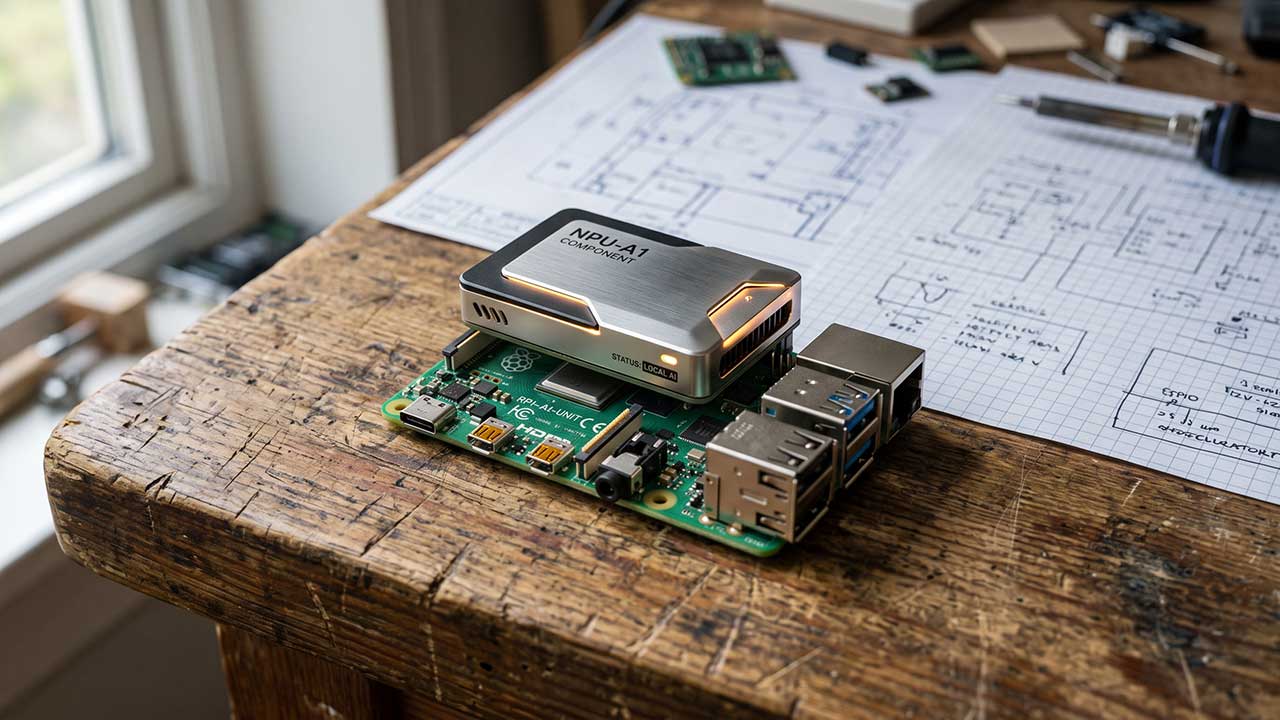
Imagine a world where that is no longer true. You buy RAM, ROM, CPUs, GPUs, and AI chips. There are Raspberry Pi-sized intelligence modules at every price point. Frontier-class capability ships as a standard part. It moves through the same supply chain as every other piece of consumer electronics. Call it component intelligence.
Component intelligence is frontier-class AI productized as commodity hardware and open weights that any company or individual can buy, own, embed, and run locally, with no dependence on a centralized model provider. It turns intelligence from a metered cloud service into a line item on the bill of materials.
Would that world be different in kind, or just different in degree?
This Has Happened Before
In 1899, electric motors accounted for less than 5 percent of mechanical drive in American factories. Stanford economist Paul David documented the lag in his 1990 essay “The Dynamo and the Computer.” Diffusion took until the 1920s to reach 50 percent, because factory owners bolted dynamos onto architectures built for steam. The productivity dividend arrived only when engineers abandoned the central drive-shaft and gave every machine its own fractional-horsepower motor.
Then something interesting happened. Consumers stopped buying motors and started buying things with motors in them. Our cars have dozens. Our homes have dozens more. The same curve swallowed the CPU. In 1970, a computer was an institution. Today, microprocessors ship inside greeting cards, and nobody calls a car a computer on wheels.
Intelligence is tracking the same curve. We are living in the central drive-shaft era of AI. One giant model in a distant data center, with your entire business belted to it. Component intelligence is the unit-drive moment, when every device, workflow, and product gets its own motor.
The Economics Are Not Simple
Skeptics will tell you the frontier model triopoly (Google, OpenAI, Anthropic) is permanent because the capital requirements are obscene. They have a point. Alphabet projected between $180 billion and $190 billion in capital expenditures for 2026, nearly double the prior year, and its rivals are spending at comparable scale. The moat is capital, energy, and silicon supply.
On the other hand, Epoch AI measured the distance between the best open-weight models and the closed frontier at roughly four months of capability (May 2026). Four months. That is the entire premium the frontier commands, and you can download the runner-up for free. Meanwhile, industry analyses put the cost decline for equivalent intelligence at roughly 10x per year, and consumption rises faster than prices fall. Economists call this the Jevons paradox. It makes a strong case that demand for intelligence is effectively infinite.
When intelligence ships as a component, the marginal cost of a decision converges on the price of energy. Pricing power migrates from whoever owns the model to whoever owns the data, the distribution, and the customer relationship. The frontier labs will still be essential and profitable but they will no longer be in charge.
The Sociology of Abundant Intelligence
The floor rises. Every small business gets a full strategy team. Every clinic in every village gets a diagnostician. That part of the story is genuinely wonderful, and we should say so without cynicism.
But the ceiling rises too. Abundant intelligence re-sorts hierarchies. When everyone has a genius in their pocket, intelligence stops being a differentiator, exactly the way literacy stopped being one. The new scarce resources are judgment, taste, proprietary data, distribution, and trust.
Politics will have to evolve much faster than it has historically. Export controls work when frontier capability lives in a handful of buildings. They stop working when it ships as silicon through a supply chain no one controls. We are already watching the first act: the most capable Western models are increasingly gated behind national-security review while capable open weights ship worldwide from labs the policy cannot reach. In a component-intelligence world, nations stop negotiating for API access and start securing fabs, energy, and talent.
Surveillance economics invert. Local intelligence is private by default, because the data never leaves the device. Innovators will love it, but regulators will hate it.
Cost Per Decision
I have argued that when deliverables only require a tap or a click, the deliverable stops being the atomic unit of business and the decision takes its place. The macro-measurement shifts from cost per deliverable to cost per decision.
Executives spent more than a few centuries managing the production of deliverables: budgets, headcount, timelines, throughput. In a component-intelligence world, production is instantaneous and effectively free. What remains is intent, judgment, and accountability.
What will an org chart look like when nobody manages production. Then ask what a P&L looks like when your competitors’ cost per decision hits zero on the same day yours does. The floor rises for everyone. The advantage goes to whoever decides best, fastest, and with the clearest values. Which may also (and ultimately will) be done by, or with the assistance of, AI.
How Far Away Is This?
Today, deploying AI into an enterprise requires forward-deployed engineers, systems integrators, and an entire deployment-services economy (which is about to emerge). Component intelligence arrives the day none of that is necessary. An AGI-class system looks at a business, understands it, and self-installs. The self-install threshold is my personal boundary marker.
Some will say never. I think they are wrong, and I think the evidence is visible right now. You can go into Best Buy right now and (for about $200) grab a Raspberry Pi 5 with a Hailo-10H AI HAT+ 2 that can easily run a one-to-three-billion-parameter language model at several tokens per second, on your desk, without a network connection. Nothing about that sentence would have been true two years ago, and nothing about it feels exotic today.
Models in the 1-to-3-billion-parameter range already run on phones. Models in the 7-to-30-billion range run on consumer laptops. While on-device capability lags the cloud frontier, the binding constraint is an engineering problem with an economic solution.
Recursive self-improvement at the edge remains speculative, and the last mile from “installable” to “self-installing” could take a few years, a decade or three. The specific timeline is debatable, but the direction of travel is clear.
Does the World Really Change?
Electricity left human nature alone and changed what was scarce. Component intelligence will follow the same pattern. Competition survives. Hierarchy survives. Ambition, status, and politics survive. What dies is the assumption that intelligence is a bottleneck.
For most of recorded history, human capability was gated by the number of smart people you could gather, train, and retain. Every institution we have, from the corporation to the university to the nation-state, is an artifact of that scarcity. Component intelligence removes the gatekeepers.
Is this more than the expected evolution of progress? In hindsight, electric motors were the expected evolution of steam. What they enabled, the assembly line, the suburb, the modern city, was a different civilization. It’s time to start thinking deeply about what we want our posterity to look like.
Author’s note: This is not a sponsored post. I am the author of this article and it expresses my own opinions. I am not, nor is my company, receiving compensation for it. This work was created with the assistance of various generative AI models.
About Shelly Palmer
Shelly Palmer is the Professor of Advanced Media in Residence at Syracuse University’s S.I. Newhouse School of Public Communications and CEO of The Palmer Group, a consulting practice that helps Fortune 500 companies with AI strategy, implementation and governance, as well as technology, media and marketing. Named one of LinkedIn’s Top Voices in Technology, he is a bestselling author, covers tech and business for Fox 5’s Good Day New York, is a regular commentator on CNN, and writes the popular daily business blog Think About This. Follow @shellypalmer or visit shellypalmer.com.