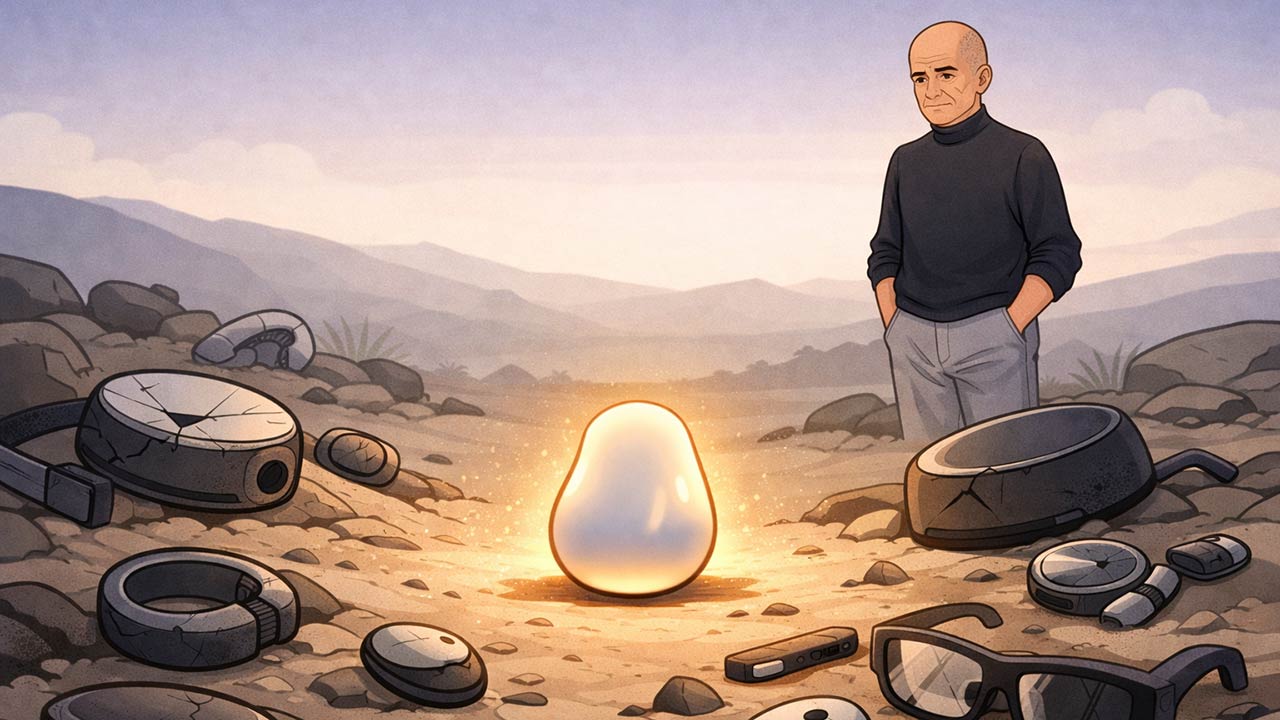
OpenAI confirmed it will unveil its first hardware device in the second half of 2026, entering a market littered with expensive failures.
Chris Lehane, OpenAI’s chief global affairs officer, made the announcement at the World Economic Forum in Davos on Sunday. He called devices “among the big coming attractions for OpenAI in 2026” but declined to specify the form factor. Pin? Earbuds? Something new? Lehane wouldn’t say.
The AI hardware track record is brutal. Humane’s AI Pin launched to devastating reviews and is now seeking a buyer. Rabbit’s R1 sold on hype and delivered disappointment. Both promised to replace your smartphone. Neither came close.
OpenAI’s bet is different in one way: Jony Ive. OpenAI acquired Ive’s io Products for $6.5 billion in May 2025, bringing in 55 engineers and the designer behind the iPhone, iPad, and Apple Watch. Sam Altman has described the device as “shockingly simple” and “peaceful,” signaling something screenless and audio-first.
Building beautiful hardware isn’t the challenge. Ive has done that for decades. The challenge is building something people will carry alongside their smartphone, or instead of it. Humane and Rabbit learned that lesson at great expense. OpenAI is betting $6.5 billion that Ive knows something they didn’t.
Author’s note: This is not a sponsored post. I am the author of this article and it expresses my own opinions. I am not, nor is my company, receiving compensation for it. This work was created with the assistance of various generative AI models.
About Shelly Palmer
Shelly Palmer is the Professor of Advanced Media in Residence at Syracuse University’s S.I. Newhouse School of Public Communications and CEO of The Palmer Group, a consulting practice that helps Fortune 500 companies with AI strategy, implementation and governance, as well as technology, media and marketing. Named one of LinkedIn’s Top Voices in Technology, he is a bestselling author, covers tech and business for Fox 5’s Good Day New York, is a regular commentator on CNN, and writes the popular daily business blog Think About This. Follow @shellypalmer or visit shellypalmer.com.