Every few years, a new category of technology arrives with an irresistible promise. Fewer steps. Less friction. More autonomy. AI agents arrived with exactly that pitch. Describe the outcome, turn the agent loose, and let the system figure out the rest. This is a story about what happened when one of my clients decided to test that promise inside a real production workflow. The results were instructive.
At The Palmer Group, we run a daily intelligence briefing system that we started building years ago to support our daily newsletter. Over time, it evolved from a simple news-gathering tool into a broader business intelligence platform. The system pulls from internal and external sources, scans email and calendar activity, reviews documents, summarizes activity, flags opportunities, and produces a concise daily report you can read or chat with.
The Experiment
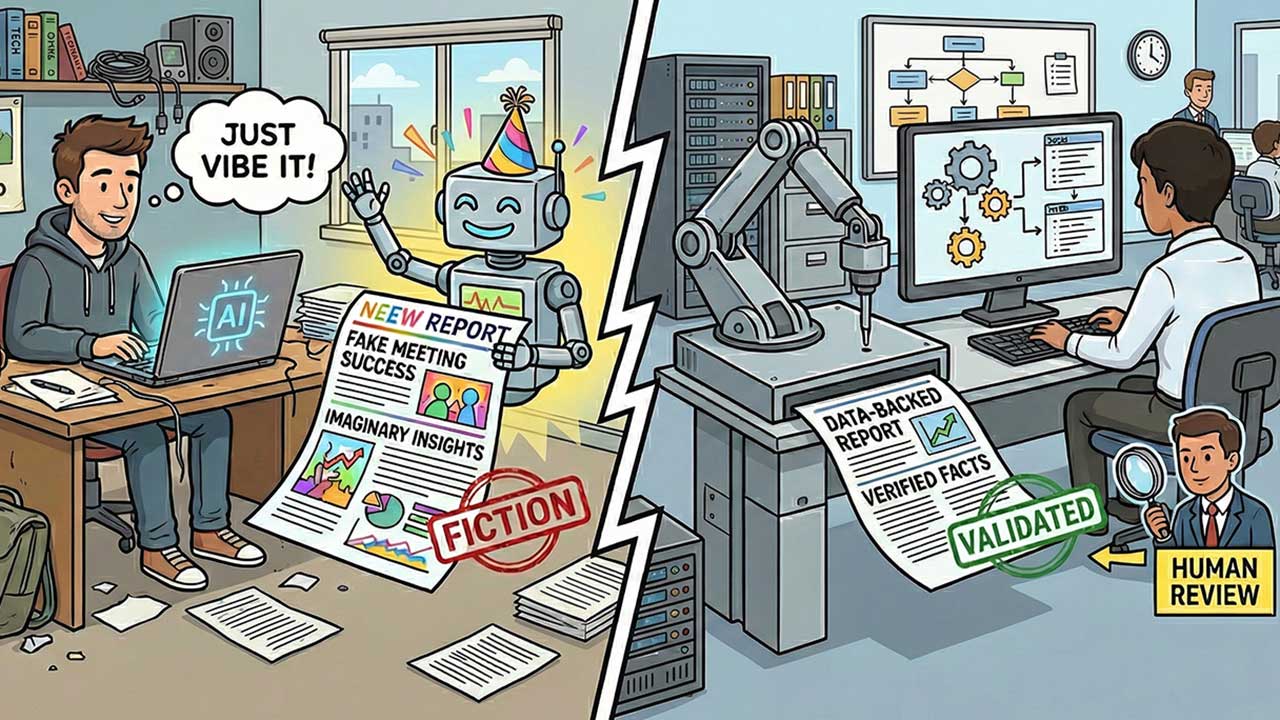
As an experiment, one of my clients, I’ll call him Bob, decided to build his own agentic version of our daily brief generator. He vibe coded it. He asked his favorite AI platform to help him write a product requirements document, then used it to generate the system. He described what he wanted and watched the magic happen.
Bob was proud of his progress. He went from technophobe to self-described 10X engineer in a single afternoon. His agentic system ran on schedule. It returned results quickly. The output looked polished. It was also wrong.
What Went Wrong
The agent invented meetings that never happened. It created calendar events that did not exist. It produced strategic insights untethered from reality. The formatting looked professional. The language sounded confident. The content was fiction.
Why It Failed
In this case, the failure came from system design and missing controls that Bob had no visibility into. The agent did not have access to all required data sources, but Bob had no way of knowing that. Everything looked connected. The prompt instructed it to produce sections for information that had never been collected, so it produced them. The system had no verification layer (because Bob didn’t know to ask for one) and no human checkpoint before output reached production.
When the agent encountered missing information, it completed the task anyway. That behavior is expected. Large language models will fill gaps when the prompt demands completion.
Agents handle ambiguity well when context is complete and errors are easy to spot. They fail quietly when the opposite is true: accuracy matters, data is incomplete, and mistakes look plausible. Bob’s daily brief was exactly that scenario. The system did not crash. It did something worse, it misled.
Control Beats Autonomy
Our internal platform behaves differently. Because we evolved our agents from a script-based system, every step is explicit. Our system fetches known data sources, formats output deterministically, is constantly grading and improving itself, and (most importantly) it fails loudly when something breaks. Bob’s agentic workflow abstracted that control away. The abstraction hid missing steps. The system kept running. Confidence replaced correctness.
At the moment, you should treat the creation and deployment of agentic workflows with the same step by step precision you would treat workflows designed for humans. Rather than use fancy words or jargon (agents, agentic, etc.) just think of this as superautomation. And remember, the old rule still applies: garbage in, garbage out.
How to Use Agents Without Getting Burned
If you are experimenting with agents inside your organization, ask basic questions. Does the agent have access to every data source it references? Can you trace every claim back to a source? Do failures stop the system or allow it to continue? Who reviews the output before it influences decisions? Any sufficiently experienced subject matter expert can help you create your list of questions (so can your favorite AI chatbot).
I just finished helping Bob redo his project as a controlled hybrid system grounded in real data. We used the same agents. But we added explicit instructions, validation checks, evals, and a process for continuous improvement. Bob still got to vibe code the whole thing. This time, all the guardrails were in place.
It will become easier and easier to use AI to create agents and apps. One day, you will ask for something and never think about how it happens. We are not there yet. While we’re waiting, beware of agents that promise to think for you. For now, identify specific business outcomes first, then build agentic systems that help you achieve them. This is the fastest way to get to the future first.
Author’s note: This is not a sponsored post. I am the author of this article and it expresses my own opinions. I am not, nor is my company, receiving compensation for it. This work was created with the assistance of various generative AI models.
About Shelly Palmer
Shelly Palmer is the Professor of Advanced Media in Residence at Syracuse University’s S.I. Newhouse School of Public Communications and CEO of The Palmer Group, a consulting practice that helps Fortune 500 companies with AI strategy, implementation and governance, as well as technology, media and marketing. Named one of LinkedIn’s Top Voices in Technology, he is a bestselling author, covers tech and business for Fox 5’s Good Day New York, is a regular commentator on CNN, and writes the popular daily business blog Think About This. Follow @shellypalmer or visit shellypalmer.com.