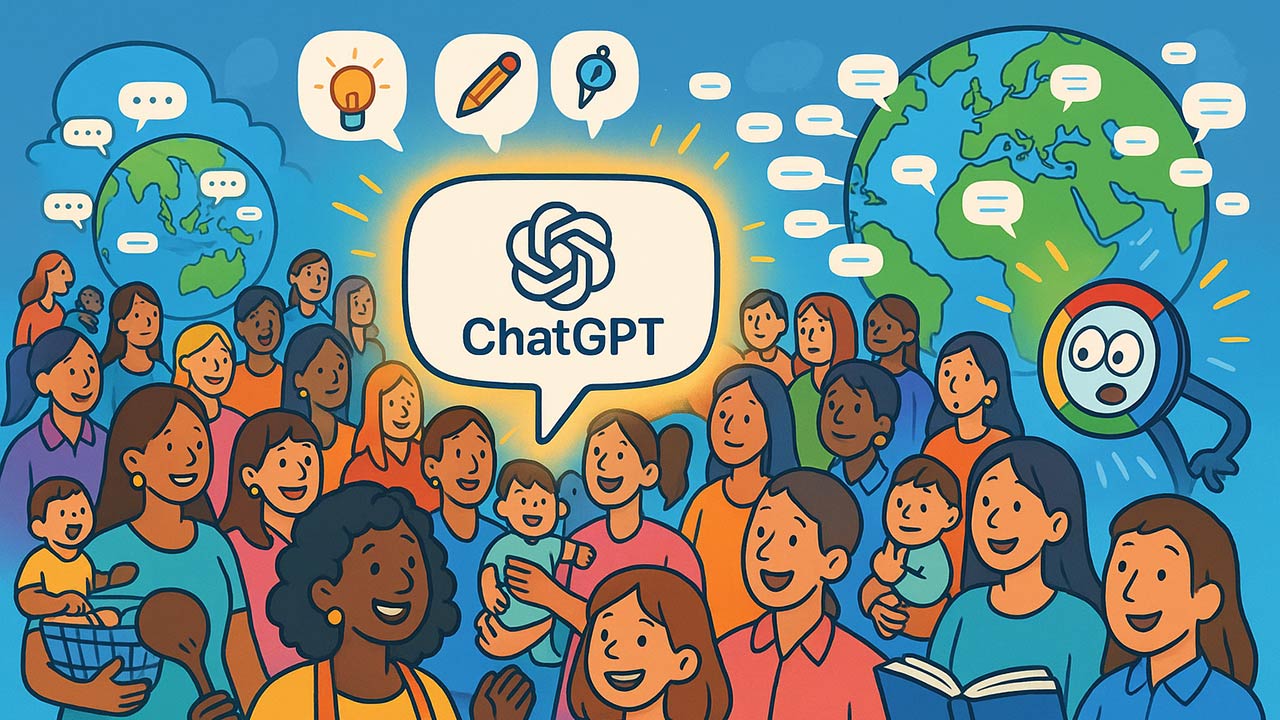
OpenAI just dropped a comprehensive study of consumer AI usage and the findings fundamentally challenge what we thought we knew about AI adoption.
The National Bureau of Economic Research working paper, analyzing 1.5 million ChatGPT conversations between June 2024 and July 2025, reveals that 70% of ChatGPT usage is personal, not professional. The share of users with typically feminine names jumped from 37% in January 2024 to 52% in July 2025. Researchers say that when women represent the majority of users for any technology platform, you’re looking at true mass market adoption.
“Seeking Information” messages now account for 24% of conversations, up from 14% a year earlier. The researchers explicitly state this “appears to be a very close substitute for web search,” which is Google’s nightmare scenario realized. That’s a quarter of ChatGPT queries that would have previously gone to traditional search. The numbers are staggering. There are something like 700 million weekly active users sending roughly 18 billion messages per week that are not hitting traditional SERPS or their related websites.
Interestingly, growth in the lowest-income countries has been more than four times that of the highest-income countries. This creates fascinating strategic implications for platform companies. AI adoption is following mobile phone penetration patterns, leapfrogging traditional infrastructure in developing markets while saturating wealthy economies.
The dominance of personal use cases explains why ChatGPT’s product roadmap increasingly emphasizes accessibility, multimodal capabilities, and user experience over enterprise features. The three dominant usage categories – practical guidance (29%), seeking information (24%), and writing (24%) – account for 77% of all conversations. Surprisingly, technical help (including programming) dropped from 12% to 5% over the past year, suggesting AI’s democratization is pulling it away from purely technical applications.
This data should reshape your AI strategy assumptions. Consumer familiarity will likely accelerate workplace adoption pressure. The information-seeking trend threatens any business model built on search traffic or information gatekeeping. Content creators, publishers, and search-dependent businesses must adapt to a world where users increasingly bypass traditional discovery mechanisms.
The 1.5 million conversation sample represents just a fraction of global AI usage, yet it reveals patterns that will define the next few years of technology adoption.
Author’s note: This is not a sponsored post. I am the author of this article and it expresses my own opinions. I am not, nor is my company, receiving compensation for it. This work was created with the assistance of various generative AI models.
About Shelly Palmer
Shelly Palmer is the Professor of Advanced Media in Residence at Syracuse University’s S.I. Newhouse School of Public Communications and CEO of The Palmer Group, a consulting practice that helps Fortune 500 companies with AI strategy, implementation and governance, as well as technology, media and marketing. Named one of LinkedIn’s Top Voices in Technology, he is a bestselling author, covers tech and business for Fox 5’s Good Day New York, is a regular commentator on CNN, and writes the popular daily business blog Think About This. Follow @shellypalmer or visit shellypalmer.com.