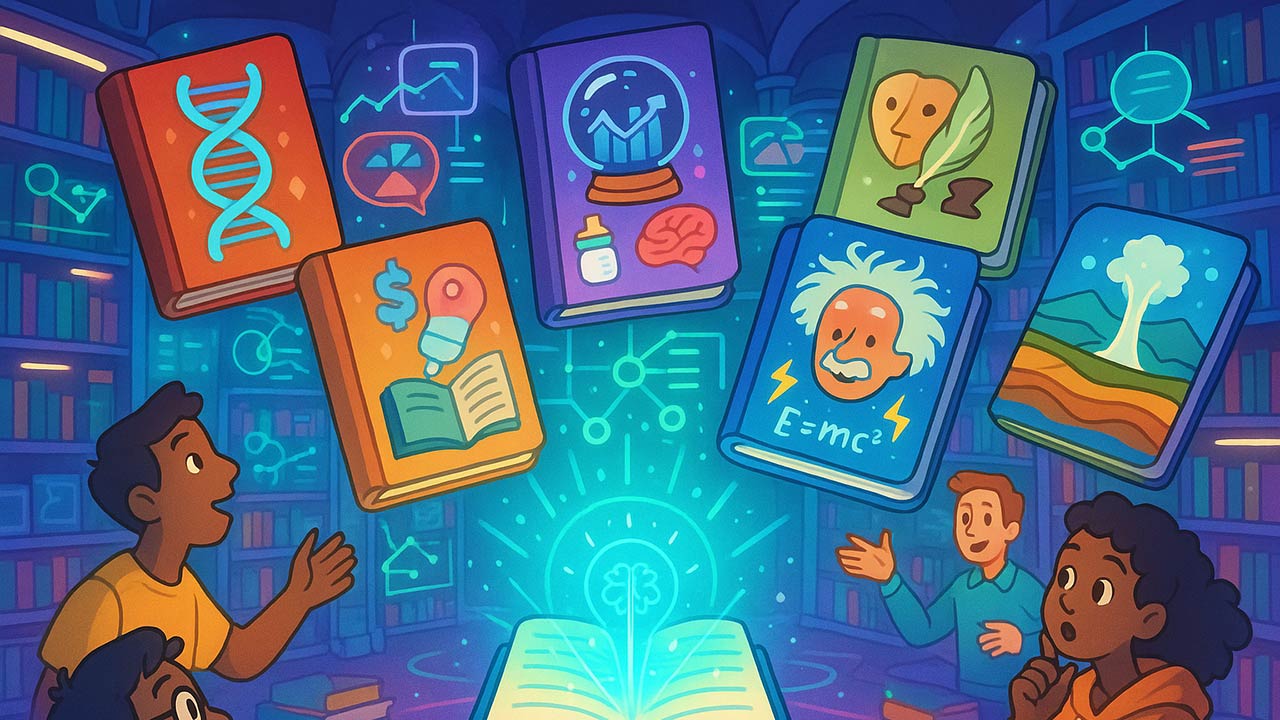
Google just launched “featured notebooks” in NotebookLM, and they’ve created something entirely new: eight curated collections from respected experts that come preloaded with interactive AI that can answer questions, generate podcast-style discussions, and create mind maps from the source material.
The lineup includes Eric Topol’s longevity advice from “Super Agers,” The Economist’s 2025 predictions, Arthur C. Brooks’ life guidance from The Atlantic, science-backed parenting tips from psychology professor Jacqueline Nesi, Shakespeare’s complete works, and a Yellowstone travel guide with geological insights.
Here’s what makes this different: you can chat with Einstein’s theories, debate with Shakespeare, or get personalized advice from world-class experts. The AI provides cited responses grounded in the original material, plus generated audio overviews that sound like expert podcasts.
This is a new product category. Traditional publishing gives you static expertise. AI chatbots give you conversation without authority. Google’s featured notebooks combine both: authoritative content from recognized experts delivered through an interactive AI interface. It’s pretty awesome.
Steven Johnson, NotebookLM’s editorial director, envisions “thousands of expert-created notebooks” available for exploration. Google reports more than 140,000 public notebooks were shared in just four weeks since they enabled public sharing last month.
It’s too soon to tell if dynamic interaction with curated content is something people will find valuable, as it requires a “lean forward” approach to learning (to grab a tired phrase from the interactive TV world). Right now, there are no conventions of learning that include this type of user engagement. We have been taught to search for answers in dialog boxes and context windows, but only a few layers deep. Here, you can go as deep as you want, but you have to know what you don’t know to get the full benefit from the content.
It’s early days, but if I had to guess, I’d say that AI’s ultimate role in this format will have to evolve into a mix of tour guide and provocateur (to both guide and incentivize additional interaction with the material). That’s what a good writer does with story arcs, or a good teacher does with class work, or a good promo director does with program teasers.
It’s easy to imagine democratized executive education. New consumer interfaces. New revenue models for publishers. And… tons of AI slop versions of everything (which is inevitable).
I really like this, and I’m going to use it to distribute a collection of AI essays and see what happens. I’ll keep you posted.
Author’s note: This is not a sponsored post. I am the author of this article and it expresses my own opinions. I am not, nor is my company, receiving compensation for it. This work was created with the assistance of various generative AI models.
About Shelly Palmer
Shelly Palmer is the Professor of Advanced Media in Residence at Syracuse University’s S.I. Newhouse School of Public Communications and CEO of The Palmer Group, a consulting practice that helps Fortune 500 companies with AI strategy, implementation and governance, as well as technology, media and marketing. Named one of LinkedIn’s Top Voices in Technology, he is a bestselling author, covers tech and business for Fox 5’s Good Day New York, is a regular commentator on CNN, and writes the popular daily business blog Think About This. Follow @shellypalmer or visit shellypalmer.com.