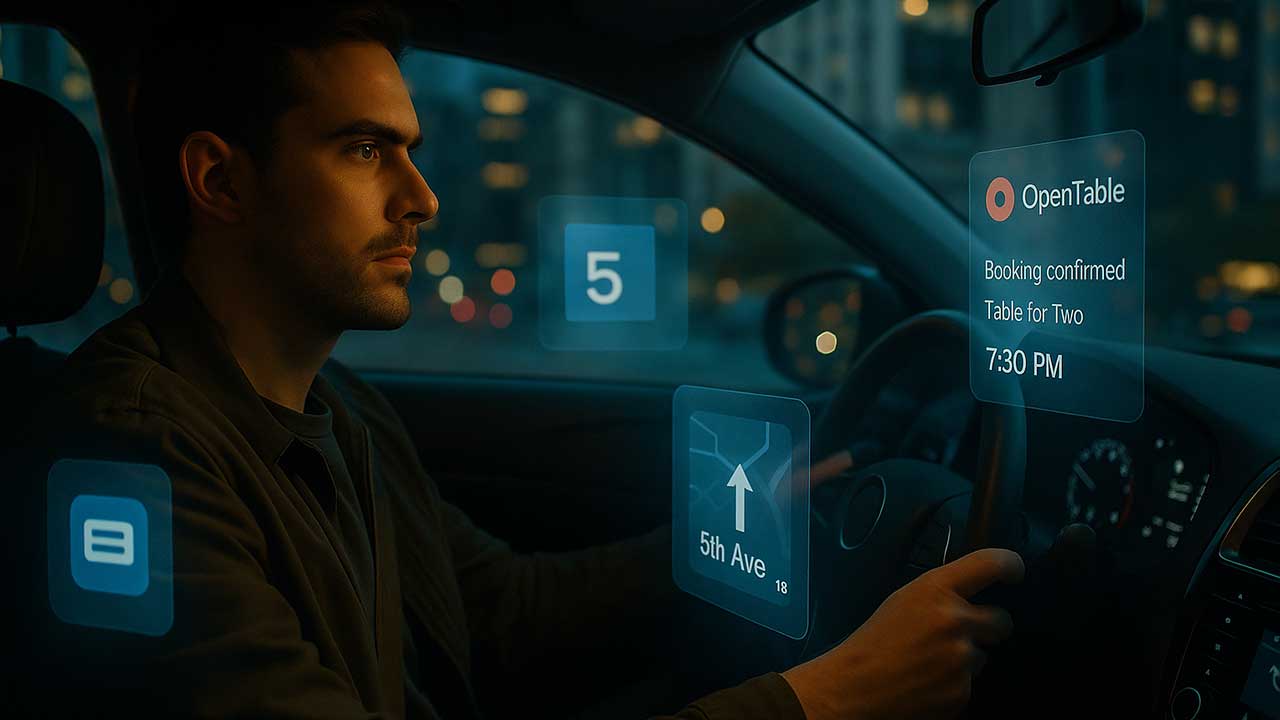
You’re running late for dinner, stuck in traffic, and realize you forgot to make a reservation. Instead of frantically switching between OpenTable, Google Maps, your calendar app, and your messaging app, you simply say: “Find me a table for two at the highest rated Italian restaurant in Midtown at 7:30 PM and text Sarah the details.”
Your AI agent books a table at the highest-rated available restaurant, moves your calendar conflicts, and sends messages to all interested parties.
This exists today.
The Death of App Hopping
Fifteen years ago, Apple coined “there’s an app for that” as it created the mobile app economy. Today, we’ve reached peak app fatigue. The average smartphone user has 80+ apps installed but regularly uses only 9. We don’t want another app; we want intelligence that works across all our apps.
OpenAI launched Operator, an AI agent that books restaurant reservations through OpenTable and assembles orders on Instacart and DoorDash by using your browser: pointing, clicking, typing, and navigating websites autonomously. Operator achieves an 87% success rate on live website navigation tasks but only works through web browsers, not mobile.
Salesforce research shows one-third of consumers prefer automated interactions over talking to humans, and 34% would use an AI agent to avoid repeating themselves.
Android 16: Built for Agents
While Apple markets iOS 26’s Foundation Models API as groundbreaking, Google shipped something more interesting with Android 16: architectural foundation for “agentic AI experiences” throughout the platform.
Development tools now include Agent Mode for complex multi-step tasks and Journeys that test apps using natural language, with Gemini performing actions autonomously across multiple app states. Key improvements include:
Notification Intelligence: Automatic notification grouping and Notification Cooldown that gradually lowers alert volume when you get bursts from the same app.
Enhanced Photo Integration: New photo picker APIs enable searching across cloud providers and apps, letting agents access your photos contextually.
System-Level Accessibility: Improved accessibility APIs enable agents to observe and interact with other applications, creating foundation for automation across apps.
Your phone can become the intelligent coordinator you’ve always wanted instead of isolated apps.
Why iOS 26 Falls Short
Apple’s iOS 26 delivers impressive visual polish with its Liquid Glass redesign and enhanced Apple Intelligence features. Call Screening gathers information from callers to help you decide whether to pick up. Hold Assist notifies you when a live agent is available. The Foundation Models framework gives developers direct access to on-device AI models.
But every capability remains sandboxed within individual apps or system-approved channels like Shortcuts. Call Screening can’t automatically reschedule your calendar when you decline a call. Hold Assist can’t coordinate with your task management apps or send status updates to colleagues.
Apple’s architectural philosophy prioritizes security and privacy through app sandboxing. This produces polished, secure experiences within individual apps but prevents coordination that defines true AI agents.
The Global Experimentation
While Apple maintains strict control, Chinese manufacturers push boundaries with open AI agent architectures.
OPPO introduced “One-Tap Screen Search,” vivo developed “PhoneGPT,” and HONOR created “MagicPortal” for functionality across apps. Chinese smartphone vendors like OPPO and Xiaomi collaborate with ByteDance to integrate the Doubao LLM for cloud-based tasks, creating open ecosystem approaches that enable sophisticated agent capabilities.
China’s AI-capable smartphone market experienced 591% year-over-year growth in Q3 2024, driven by local vendors’ rapid progress in model optimization, open ecosystems, and privacy frameworks. These manufacturers experiment with AI agent features at scale, testing what consumers want rather than what platform gatekeepers allow.
The Plot Twist: Big Tech’s Direct Play
While we debate agents working across apps, foundational model builders and hyperscalers make a different bet. Instead of enabling agents to work across existing apps, they’re cutting out the middleman.
OpenAI’s Operator has direct partnerships with Booking.com, Tripadvisor, Priceline, Hipcamp, Uber, StubHub, and OpenTable. Perplexity announced partnerships with Tripadvisor and Selfbook, allowing travelers to book hotels directly within Perplexity’s AI chatbot. Google’s Gemini integrates with Google Flights, Hotels, and Maps to provide real-time travel assistance, with AI Overviews helping users create itineraries and hotel price tracking launching globally.
These partnerships make apps irrelevant.
When a hotel chain builds a travel planner powered by Google Cloud AI and Meta targets hundreds of millions of businesses for agentic AI deployment, they’re creating monopolized experiences where the AI platform becomes the sole interface between you and services.
Analysts predict that by 2025, personal digital assistants will handle room, table, and amenity bookings end-to-end, skipping today’s intermediaries. The question isn’t whether Android’s architecture beats iOS’s sandboxing but whether either matters when Google, OpenAI, and Meta control the entire transaction pipeline.
Two Probable Futures
OpenTable was the first restaurant tech partner for OpenAI’s Operator tool, making it easier for diners to book reservations with AI requests like “Book me a table for two at Beretta tonight at 7PM.” You don’t need coordination across apps when the AI platform talks directly to the restaurant’s booking system.
This is the emerging future: not apps talking to each other, but AI platforms talking directly to service providers. Your choice isn’t between Android’s openness and iOS’s control but between Google’s ecosystem, OpenAI’s partnerships, Meta’s business integrations, and whatever Amazon, Microsoft, and others are building.
The mobile platform determines how polished your AI features are, but the AI platform determines whether you have any choice at all.
Android 16 provides better architecture for agents across apps. iOS 26 provides better security for sandboxed AI. But both may solve yesterday’s problem while tomorrow’s monopolies form around direct AI-to-service pipelines that bypass mobile apps.
Who will win?
The age of “there’s an app for that” is ending. The age of “there’s an agent for that” is beginning. But who will control the agents? Device makers? That’s where you PII and PHI live. Carrier Networks? That’s where a pure intelligence layer could shine. Foundational model builders and hyperscalers? They have a direct path to instant agency? All three?
The future will likely be less about which phone you carry and more about which AI overlord(s) you serve.
Author’s note: This is not a sponsored post. I am the author of this article and it expresses my own opinions. I am not, nor is my company, receiving compensation for it. This work was created with the assistance of various generative AI models.
About Shelly Palmer
Shelly Palmer is the Professor of Advanced Media in Residence at Syracuse University’s S.I. Newhouse School of Public Communications and CEO of The Palmer Group, a consulting practice that helps Fortune 500 companies with AI strategy, implementation and governance, as well as technology, media and marketing. Named one of LinkedIn’s Top Voices in Technology, he is a bestselling author, covers tech and business for Fox 5’s Good Day New York, is a regular commentator on CNN, and writes the popular daily business blog Think About This. Follow @shellypalmer or visit shellypalmer.com.