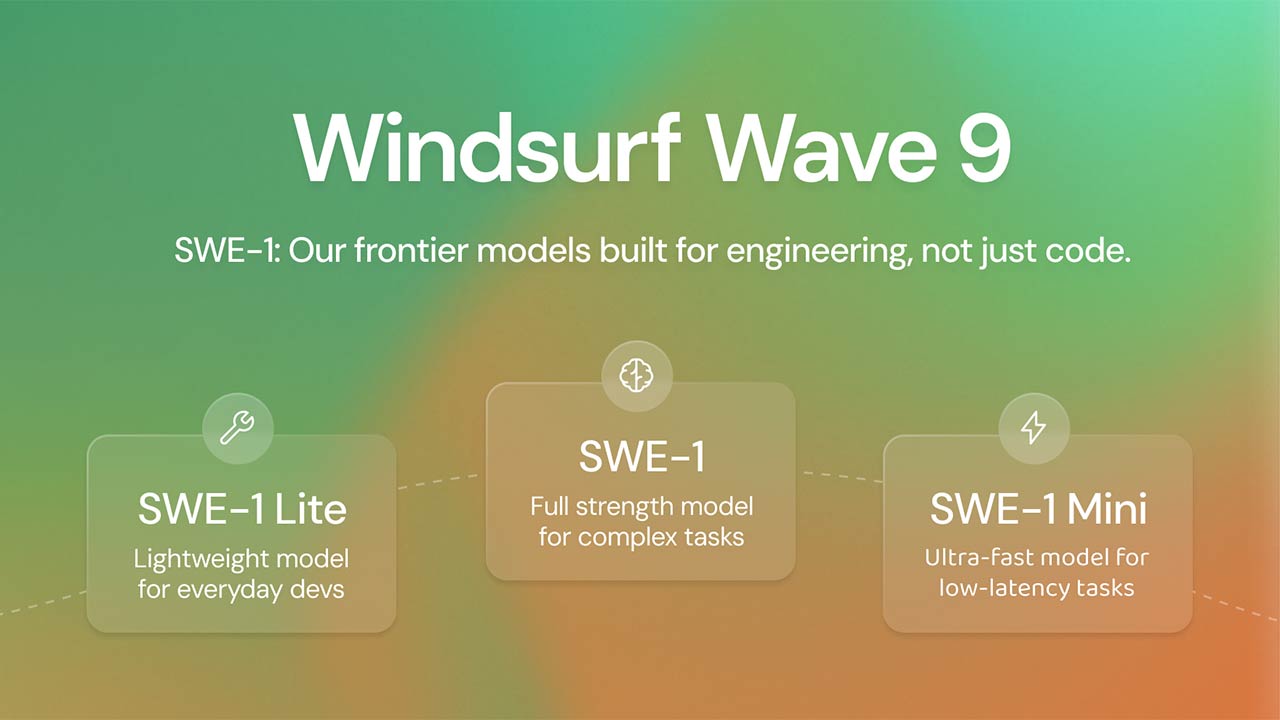
Windsurf, the AI coding startup that is reportedly in the process of being acquired by OpenAI for $3 billion, just launched SWE-1: its first in-house small language model designed specifically for software engineering. Released under its new “Vibe” lineup, the model is open-weight, fast, and compact. It is built to run efficiently on consumer hardware without relying on expensive cloud infrastructure.
This is not just another open model release. SWE-1 is fine-tunable and available for commercial use under a permissive license, giving developers the freedom to adapt it as needed. The key takeaway is that SWE-1 delivers credible performance on benchmark coding tasks with only 9 billion parameters, which shows how much ground small models have gained in capability and usability.
The implications line up with my thesis: “Within 36 months, both code and content will be free.”
With models like SWE-1, developers no longer need GPT-4 or Gemini to generate functional, high-quality code. A cloud connection is not required. Local-first, open-weight AI is removing friction between idea and execution.
As code becomes free to generate, remix, and deploy, content will follow the same path. Vibe-everything models are accelerating the shift. This is no longer just democratization. It is deflation. The marginal cost of creating digital content (of every kind) is quickly approaching zero.
Windsurf’s announcement is a clear signal that the value is moving away from creation and toward distribution. The technical edge is shrinking. The competitive edge now lies in culture, community, and strategy. In a world where anyone can build, scale is the differentiator.
In a world where code and content are free, the battle for trust will be the final frontier.
Author’s note: This is not a sponsored post. I am the author of this article and it expresses my own opinions. I am not, nor is my company, receiving compensation for it. This work was created with the assistance of various generative AI models.
About Shelly Palmer
Shelly Palmer is the Professor of Advanced Media in Residence at Syracuse University’s S.I. Newhouse School of Public Communications and CEO of The Palmer Group, a consulting practice that helps Fortune 500 companies with AI strategy, implementation and governance, as well as technology, media and marketing. Named one of LinkedIn’s Top Voices in Technology, he is a bestselling author, covers tech and business for Fox 5’s Good Day New York, is a regular commentator on CNN, and writes the popular daily business blog Think About This. Follow @shellypalmer or visit shellypalmer.com.