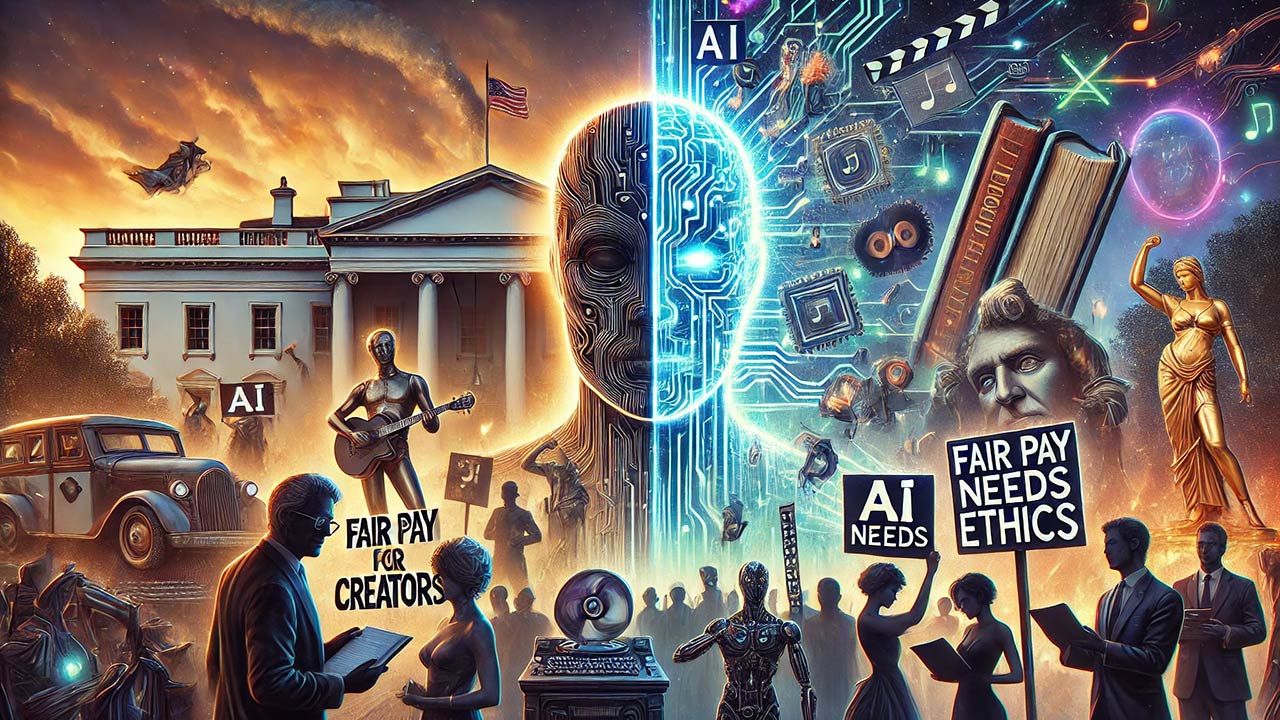
Last week, Google and OpenAI asked the White House for permission to train AI on copyrighted content, arguing that restrictive laws will cripple U.S. innovation while China advances unchecked. Their case: AI doesn’t copy; it learns patterns and creates something new. That’s fair use, they claim—the same principle that powers search engines and chatbots.
Hollywood disagrees. Yesterday, 400+ industry leaders—including Ron Howard, Cate Blanchett, Paul McCartney—sent a letter warning that this would open the floodgates to unlicensed use of scripts, music, and books. You can read the full text of the referenced letters here.
What’s at Stake?
Unrestricted AI training could accelerate breakthroughs in medicine, automation, and more, but if creators aren’t compensated, what’s their incentive to keep creating? Given Big Tech’s market caps, the idea that they can’t afford to pay creatives is absurd.
If AI can generate a mash-up like “a painting of a farmhouse mixing the styles of Yayoi Kusama and Tetsuya Nomura” or “music for a chase scene that sounds like Hans Zimmer’s Pirates score,” shouldn’t the referenced artists get paid?
We need a licensing model, a performing rights society for AI, or an opt-in dataset. This isn’t an either-or—we can win the AI race and fairly compensate creators. In practice, we have to.
Author’s note: This is not a sponsored post. I am the author of this article and it expresses my own opinions. I am not, nor is my company, receiving compensation for it. This work was created with the assistance of various generative AI models.
About Shelly Palmer
Shelly Palmer is the Professor of Advanced Media in Residence at Syracuse University’s S.I. Newhouse School of Public Communications and CEO of The Palmer Group, a consulting practice that helps Fortune 500 companies with AI strategy, implementation and governance, as well as technology, media and marketing. Named one of LinkedIn’s Top Voices in Technology, he is a bestselling author, covers tech and business for Fox 5’s Good Day New York, is a regular commentator on CNN, and writes the popular daily business blog Think About This. Follow @shellypalmer or visit shellypalmer.com.