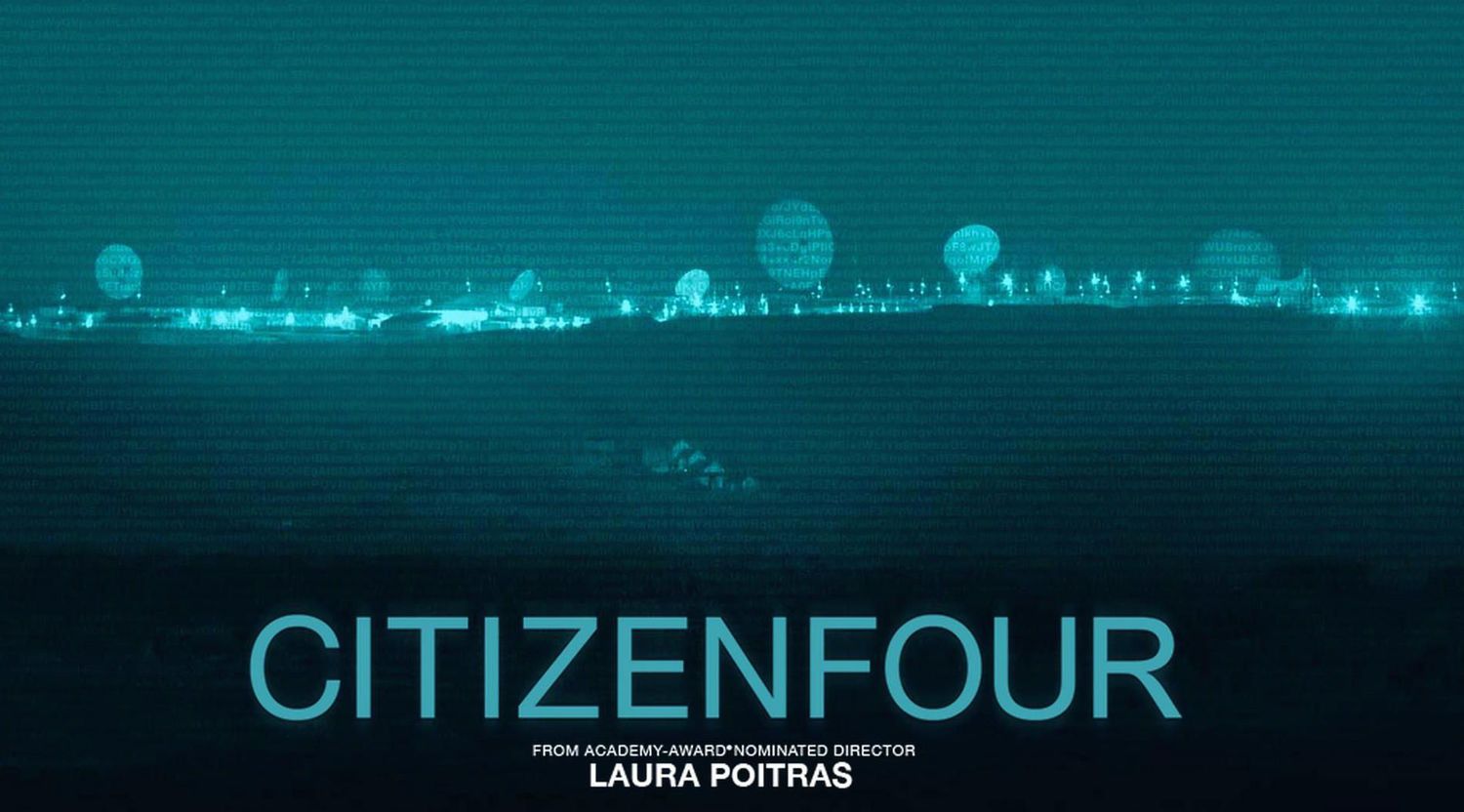
I just saw Laura Poitras’s skillful documentary about Edward Snowden and the NSA spying scandal, Citizenfour. The film doesn’t reveal significant facts that we haven’t already learned from the articles that followed Snowden’s document leaks and Glen Greenwald’s subsequent book that tells the intriguing story of those leaks. However, Citizenfour does portray the characters involved and let them speak to the camera.
The documentary is provocative because like the preceding articles and book it challenges the US government’s right to intercept communications (“sigint”) of US citizens and condemns officials’ lying about their activities. It also portrays Snowden as a martyr for freedom and privacy. Skeptics have questioned Snowden’s motives and patriotism, but you have to be quite cynical to believe that he hoped to personally gain from his leaks, and even more so to believe that he intended to subvert America and aid Russia or China.
Regardless of Snowden’s personal issues, what we learn from this drama is that communications surveillance is absolutely pervasive. The US government does it, we know China does it, and we can assume that most of the sophisticated national intelligence agencies around the world do it as well.
Because I run a company that provides private online conversation, I have discussed this situation with many people. Most often people tell me something like, “Well, OK, it’s not ideal, but I’m not worried, I don’t have anything to hide.” Viewers of Citizenfour will see the flaws of this logic.
Every oppressive regime of the modern era has relied on relentless surveillance, and every dystopian book or movie I know of similarly represents power through surveillance and the information control. It may be true today that US intelligence honestly wants to use every tool it can to fight terrorism, without further ambitions. But we know from history that when a powerful apparatus exists, it will inevitably be used and potentially abused. A right to privacy — as any right — does not exist only to protect criminals and cheats. Rights only survive when they are vigilantly protected for all. Can you imagine anyone saying, “I don’t really need freedom of speech because I don’t say anything the government would want to suppress”?
The NSA documents Snowden leaked describe how telcos turned over all of their metadata — information about who called whom and when. In the PRISM program, tech companies share their clients’ data on demand. And there are several more. These are threats to your ability to have a private conversation (if you’re not sitting in a rowboat in the middle of a lake).
There are other threats besides the US government. Foreign governments collect their own data. We have been warned by the FBI director, James Comey, that China is always aggressively probing for data. We know hackers regularly steal passwords from unsecured sites, mostly for identity theft, or just plain theft. These are external security threats, from people you cannot detect.
Internal threats also impede your ability to have a private conversation. I call them internal because they come from people you know, or at least know of. They are coworkers, friends, roommates, family members, and management. When your kid plays with your iPhone or your email program is up on your screen all day, your messages are exposed. And conversely, when you write a message to someone, you have no idea where she will be when she receives it. How private is her setup? So you self-censor when you write.
This constellation of threats to private conversation leads many to shrug and say privacy is dead. The good news is that privacy is not dead. The easy part is that you can quite easily use software to protect your communications and stored data. It will take longer to modify our laws to protect our rights and provide some transparency to government actions.
Eric Liftin, Founder and CEO of Tunnel X, has been designing for the web since that became an occupation. Eric and his business partner, Steve Schneider, founded Tunnel X on the theory that everyone doesn’t want to be social online all the time. Sometimes we want just the opposite: a private space to have a secure conversation. Liftin has lived in New York City since 1990 and resides in Brooklyn with his wife, Elizabeth Schmidt, and two children. Eric received an M.Arch from Columbia and a BA in literature from Yale.
About Shelly Palmer
Shelly Palmer is the Professor of Advanced Media in Residence at Syracuse University’s S.I. Newhouse School of Public Communications and CEO of The Palmer Group, a consulting practice that helps Fortune 500 companies with AI strategy, implementation and governance, as well as technology, media and marketing. Named one of LinkedIn’s Top Voices in Technology, he is a bestselling author, covers tech and business for Fox 5’s Good Day New York, is a regular commentator on CNN, and writes the popular daily business blog Think About This. Follow @shellypalmer or visit shellypalmer.com.