I’m on my way to the Cannes Lions Festival and I’m looking forward to an incredible week. AI will be at the front and center of almost every conversation, and I am pretty sure that many (if not most) of these talks will focus on exactly the wrong thing.
In 1990, economist Paul David published “The Dynamo and the Computer: An Historical Perspective on the Modern Productivity Paradox.” It documented one of the most useful lessons in industrial history.
Electricity did not fail. Factories failed to reorganize around it. In the 1880s, factories began installing electric motors. The biggest productivity gains did not show up until the 1920s. Thirty to forty years passed between the technology becoming available and the technology paying off at scale. David’s explanation was simple: the first generation of factory owners used electric motors to preserve old architectures. They replaced the steam engine and kept the line shafts. The big gains came later, when factories were redesigned around what electricity made possible.
This is the right frame for enterprise AI deployment. The productivity is sitting on a floor plan that was designed for a different machine.
Same Building, New Engine
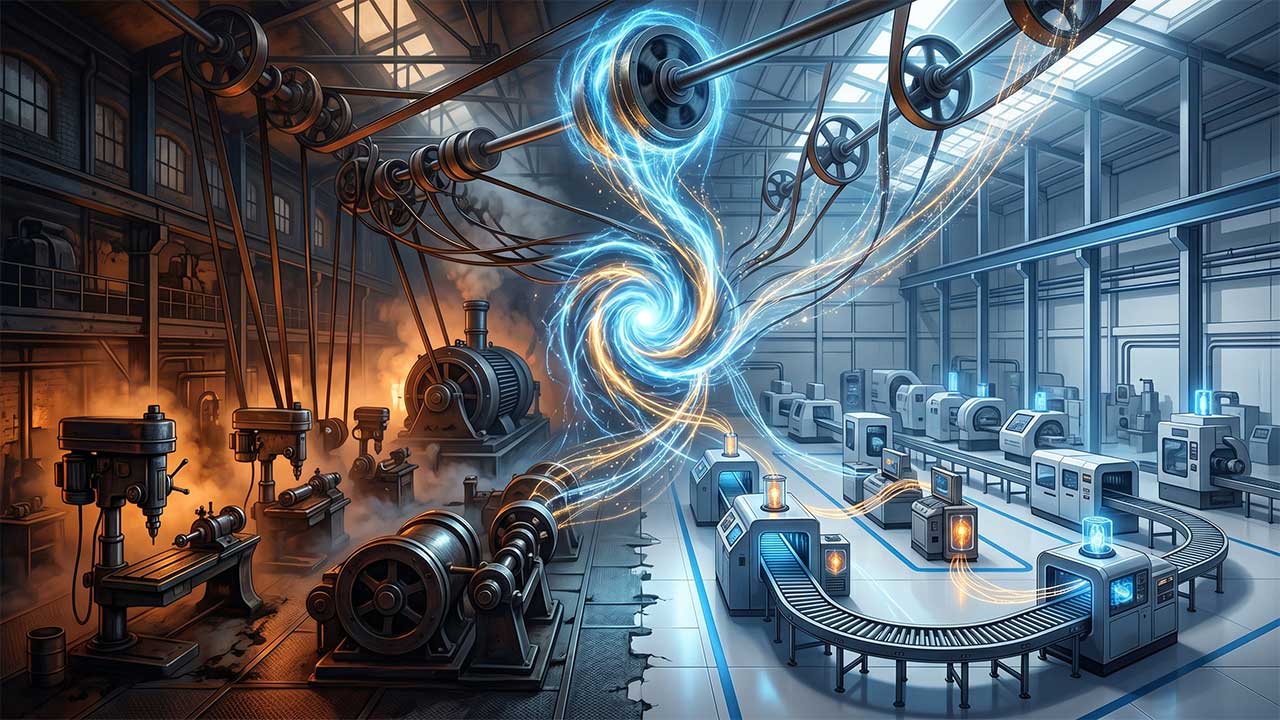
A pre-electrification factory was a building wrapped around a power source. A steam engine turned a drive shaft that ran the length of the ceiling. Leather belts dropped from the shaft to power every machine on the floor. Every drill press, every lathe, every loom sat where the belt could reach it. The building, layout, supervision hierarchy, rhythm of the workday: all of it followed from one shaft turning and a bunch of leather belts.
The first stage of industrial electrification often looked like a one-for-one swap. Owners pulled out the steam engine and dropped in a large electric motor. The shaft stayed. The belts stayed. The building stayed. The layout stayed. They electrified the factory and changed almost nothing about how the factory worked. Productivity gains were immeasurable.
This is the position many companies are in right now. They are replacing metaphoric steam powered factory floor with an electric one and are calling it AI transformation.
The Unit-Drive Moment
After 1900, smaller industrial motors became commercially available, and the architecture of the factory could change. Power no longer had to travel from a central source through a mechanical drive train. A motor could sit on each machine. Line shafts could come out. Friction losses from the drive train could disappear. Owners could place machines wherever the work wanted them, not wherever the shaft happened to reach. They could reorganize floors around the flow of materials, the sequence of operations, and the path of the worker.
In 1913 Ford’s Highland Park factory added a moving assembly line. The facility still depended on an on-site powerhouse, and its power architecture was not pure. The work architecture was the breakthrough. Ford rearranged magneto assembly into a moving line, divided the work into discrete operations, and cut assembly time from 20 minutes to 13 minutes, then to five minutes. A 75 percent reduction in cycle time.
A Title That Disappeared
In 2006, I wrote a book called Television Disrupted (Focal Press). One passage used the “Vice President of Electricity” to describe a job that made sense when electricity was complex, bespoke, and operationally risky. “Back then, if you needed industrial quantities of electricity, the best (and possibly only) way to get it was to generate it yourself.” And later: “It was not the advent or existence of utility electrical grids that ended his career, it was simplicity. As soon as there was a simple, easy alternative to a complex problem, everyone jumped on it.”
The job function matters more than the corporate title. Someone had to procure power, specify equipment, manage fuel, oversee reliability, and translate a technical system for executives who did not understand it. He understood his domain at a depth no one else in the C-suite could match. Then electricity became simple enough to disappear into the operating environment. That is what kills specialist empires: not irrelevance, but simplicity. The same book called out utility-grid computing, which we now call cloud, as a world-changing technology. The pattern is repeating with AI.
The Same Job, Different Title
Many of my clients now have a Chief AI Officer, or a head of AI transformation, or an AI Center of Excellence with a senior executive at the top. Too many of them are running the Vice President of Electricity playbook. They handle procurement. They write the specifications. They negotiate with Anthropic, OpenAI, Google, Microsoft. They run the governance committee. They commission the security audits. They benchmark cost per token across providers. They publish the responsible-use framework. All of this is necessary work, and none of it redesigns a single workflow.
AI procurement, governance, vendor reviews, and cost-per-token benchmarking are now simply table stakes. But if the org chart, meeting cadence, decision rights, approval loops, escalation paths, role definitions, team structures, planning horizons, and performance reviews all serve a workforce that thinks at human speed, fatigues, gets defensive, has a political memory, and runs in one thread at a time, AI will be no more productive than an electric motor connected to a drive shaft and a bunch of leather belts.
What AI-Native Means
The phrase “AI-native” is overused and underdefined. Define it the way unit-drive factories defined electric-native. An AI-native workflow is one that could not have existed before machine-speed reasoning, cheap large-scale parallelism, tireless review, and systems without fatigue, defensiveness, or status anxiety became available inputs to the work. It is not a chatbot beside the old workflow. It is a new workflow, rebuilt around those capabilities.
Earlier this year, George Sivulka of Hebbia published a sharp essay, “Institutional AI vs Individual AI,” that asks the right question: “AI just made every individual 10x more productive. No company became 10x more valuable as a result. Where did the productivity go?”
Sivulka points to seven pillars: coordination, signal, bias, edge, outcomes, enablement, and unprompted action. Each one is a consequence of redesigning the floor. You earn coordination by rebuilding how decisions move through the organization. You earn edge by rebuilding what your people spend their time on. Vendors do not sell either one. They sell power. You still have to redesign the factory.
The Five-Year Clock
Paul David gave us a thirty-year warning. We don’t have that kind of time. At the speed of AI innovation, we’ll start to see this happening before the end of the decade.
Simplicity ended the Vice President of Electricity’s job. Unit-drive factories beat line-shaft factories on workflow, not on power. The next chapter of corporate value creation will belong to leaders who overcome the cultural debt, rip out the drive shafts, and go AI-native.
Author’s note: This is not a sponsored post. I am the author of this article and it expresses my own opinions. I am not, nor is my company, receiving compensation for it. This work was created with the assistance of various generative AI models.
About Shelly Palmer
Shelly Palmer is the Professor of Advanced Media in Residence at Syracuse University’s S.I. Newhouse School of Public Communications and CEO of The Palmer Group, a consulting practice that helps Fortune 500 companies with AI strategy, implementation and governance, as well as technology, media and marketing. Named one of LinkedIn’s Top Voices in Technology, he is a bestselling author, covers tech and business for Fox 5’s Good Day New York, is a regular commentator on CNN, and writes the popular daily business blog Think About This. Follow @shellypalmer or visit shellypalmer.com.