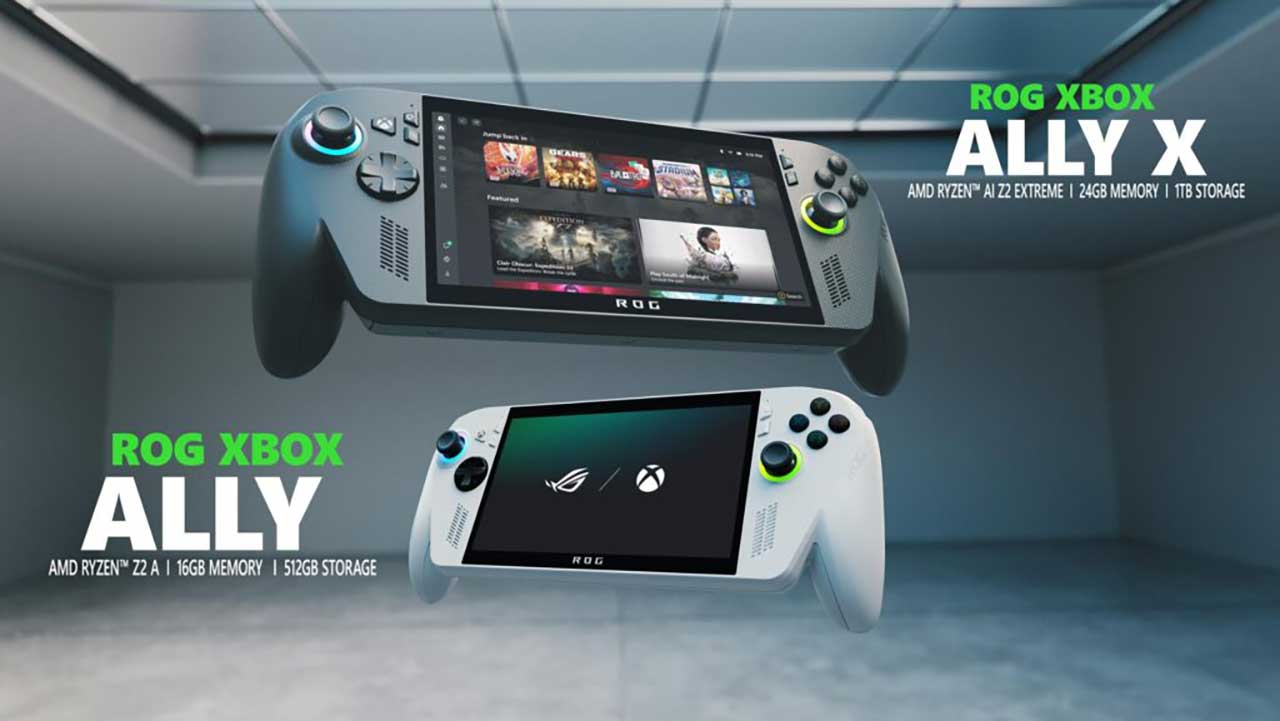
The Xbox brand has been in a strange place lately. Game Pass Ultimate just got 50 percent more expensive (and 50 percent more confusing to parse through its tiers). Hardware prices keep inching up. Microsoft wants us to think of everything as simply “an Xbox” (your console, your PC, your phone, your TV), but that universality feels more confusing than cohesive. Into that confusion walks the Asus ROG Xbox Ally: a handheld that wants to be the best of all those worlds at once.
I was sent a review unit of the $599 model, and while it’s exciting in theory (a true Xbox handheld!), in practice, it sits squarely in the uncanny valley between console and PC. It made me wonder if the Xbox brand knows what it is in 2025.
Hardware and First Impressions
Physically, the ROG Xbox Ally looks and feels great. The unit’s slightly rounded grips and sturdy frame are easy to hold for long sessions, and the illuminated joystick rings are a slick touch that instantly make the device feel premium. It’s roughly the weight of a Nintendo Switch 2 but denser and more serious, like a gadget that means business.
I’ve been predominantly an Xbox gamer since 2002, so the idea of having access to most of my purchased library (and Game Pass for PC) on a handheld was thrilling. And in fairness, when it works, it really works. Indie titles like Balatro, Hollow Knight, and UFO 50 played beautifully. The visuals were crisp, inputs responsive, load times quick. For my current play habits, this was bliss.
The hardware feels more than capable, even in this “lower-end” configuration. (Though, to be fair, I tested mostly indie games, rather than more robust/demand games like Doom: The Dark Ages.) Still, I can’t help but wonder if the $999 ROG Xbox Ally X (the more expensive and more powerful model) is the one that actually fulfills the promise of a true Xbox handheld. Because this one, while good, doesn’t quite feel finished.
Software: The Messy Middle
If there’s one word for the software experience, it’s clunky. The interface feels like a patchwork of Xbox OS, Windows 11, and Steam Deck cosplay, all trying to coexist without a clear hierarchy. Menus pop up cropped or misaligned. Closing out of the PC Game Pass window often means hunting for the right combination of menu and escape keys.
When I say it doesn’t “just work,” I don’t mean that flippantly. On a Switch 2 or a Steam Deck, navigation feels natural and single-purpose. Here, it’s like piloting a starship where every lever does three things depending on which subsystem is active.
There are too many buttons, which is not confusing as much as distracting. Xbox seems determined to make one device for everyone: console players, PC enthusiasts, Game Pass subscribers. However, that ambition spreads the experience thin. You never quite feel like you’re playing a console or a PC. You’re playing something else, something between. This is not a good thing.
The Platform Problem
There’s a bigger issue lurking beneath the surface, one that’s less about the Ally itself and more about what Xbox is becoming. Microsoft keeps blurring the line between console and PC, subscription and ownership, hardware and ecosystem.
That vision sounds great on paper: seamless cross-play, shared libraries, cloud saves. But in execution, it’s messy. Not every PC Game Pass title runs smoothly on Windows handhelds. Not every Xbox game supports cloud streaming. Not every “Xbox” behaves the same way.
This isn’t just a device problem; it’s an identity problem. The ROG Xbox Ally embodies that confusion: ambitious, technically impressive, but unsure what it wants to be when it grows up.
The Price of Potential
I’d love to test the higher-end Ally X. The specs suggest a device that could genuinely rival the Steam Deck OLED or even Apple’s upcoming gaming initiatives. But at $999, it’s a tough sell.
It’s not that I doubt Asus’s engineering; it’s that Microsoft’s software strategy still feels unsettled. Buying the more powerful unit feels like paying extra for hope.
Verdict
The ROG Xbox Ally is, at its core, a fascinating experiment, and (hopefully) the start of something special. It’s proof that Microsoft’s gaming ambitions have outgrown the traditional console, but also that they haven’t yet found their footing in the hybrid future they keep promising.
When it’s working, it’s magic: your favorite games, wherever you are, on a device that feels great in your hands. When it’s not, it’s friction incarnate: menus that don’t close, downloads that don’t launch, and an OS that seems to sigh every time you ask it to act like a console.
For now, this handheld sits in a liminal space: part PC, part Xbox, not quite either. It’s an exciting glimpse of what might come next, but also a reminder that sometimes, ambition outpaces readiness.
If Microsoft wants us to think of everything as “an Xbox,” they’ll need to make sure it feels like one. Until then, I’ll keep playing where it’s easiest, cheapest, and most reliable… because brand loyalty only goes so far when convenience wins every time.
Author’s note: This is not a sponsored post. I am the author of this article and it expresses my own opinions. I am not, nor is my company, receiving compensation for it. This work was created with the assistance of various generative AI models.
About Joey Lewandowski
Joey is the Manager of Content and Community at ShellyPalmer. With a journalism degree from Ramapo College of New Jersey, he's a die-hard Minnesota Vikings fan, enjoys watching movies and loves all most things tech. You can follow him on Twitter @soulpopped.