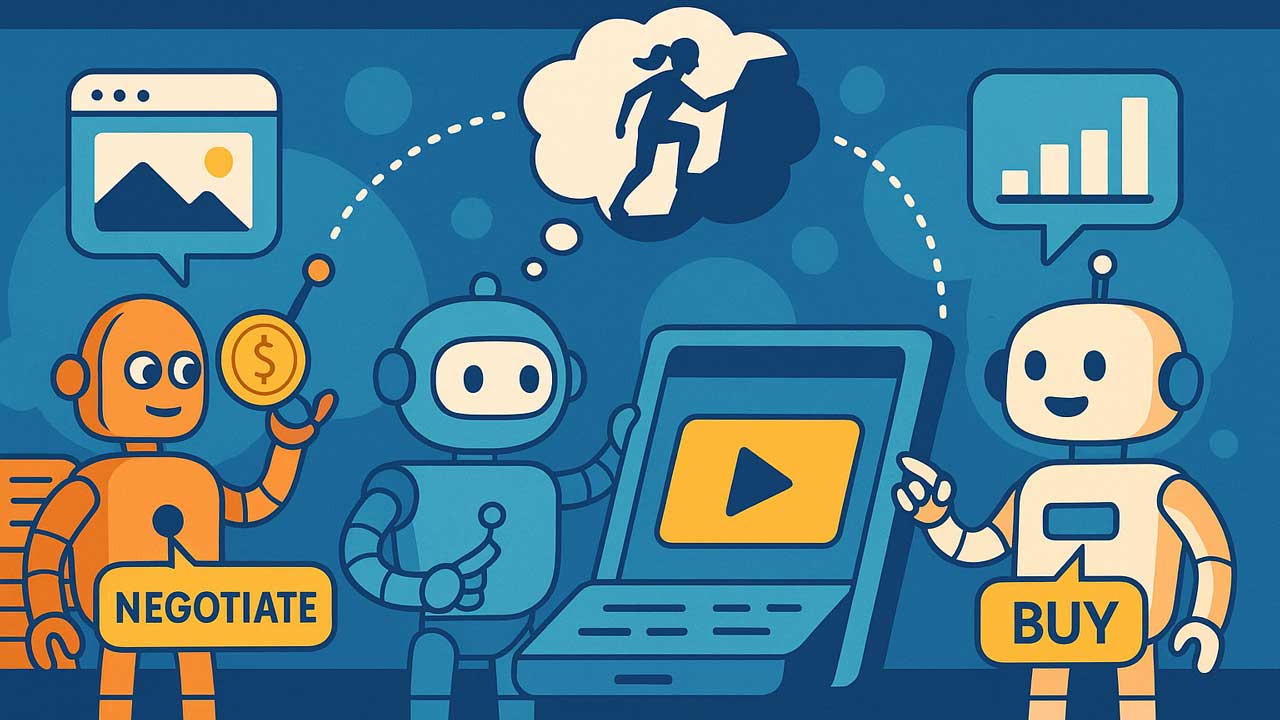
Programmatic advertising is built on humans setting rules for machines. Agentic advertising flips that model. Instead of people operating dashboards, AI agents brief, negotiate, and buy directly across platforms. To make work at scale, the industry needs shared plumbing.
On October 15, 2025, a consortium led by Yahoo, PubMatic, Optable, Scope3, Swivel, and Triton Digital launched the Ad Context Protocol (AdCP), an open standard that lets AI agents exchange context and orchestrate buying across ad platforms. Let’s explore.
What AdCP Is
AdCP proposes a common interface for “agentic” advertising workflows. It is built on MCP (Model Context Protocol), a standard for connecting AI agents to tools and data. According to the specification the initial modules are: Signals Activation Protocol, Media Buy Protocol, and Creative Protocol; the Curation Protocol is marked as “Coming Q2 2025.”
With AdCP, a marketer can ask an agent to “Find audience signals of premium sports enthusiasts.” The agent can then autonomously negotiate with publisher and platform agents to identify suitable audiences, formats, and prices. The protocol’s purpose is to expand programmatic advertising into an environment where machines handle planning and buying within defined governance.
Who Is Behind It
Founders include: Yahoo, Optable, PubMatic, Scope3, Swivel, Triton Digital. Launch members include Magnite, Kargo, Raptive, LG Ad Solutions, The Weather Company, AccuWeather, Butler/Till, Classify, Samba TV, and others. Governance is described as a “neutral working group.”
You can review the spec at github.com/adcontextprotocol/adcp. The repo houses docs and a reference implementation.
The Case For AdCP
AdCP targets three persistent problems: integration cost, workflow fragmentation, and limited cross-platform orchestration for agents. If it works, teams will issue natural-language briefs, agents will translate those into standardized requests, and platforms will respond in a shared schema. As Adweek and AdExchanger framed it, this is an attempt to make sense of agentic demand and reduce the industry’s “opaque intermediary layers” over time.
How Real Is This?
The GitHub repo is public (first release v2.0.0, Oct 15 2025). The working group has open membership. This is not a vaporware press release. That said, as of this writing, the repo does not show a SECURITY.md and there are no published security advisories. This is unsurprising at launch, but a signal to watch if agents will transact budget.
More than 20 firms have committed at launch, spanning sell-side, data, curation, and measurement. That breadth increases the odds of useful pilots across CTV, display, and retail media, but real traction will require a major DSP (or two) and several top-tier publishers to implement endpoints that can handle real briefs, budgets, and pacing. Early coverage suggests AdCP is designed to complement existing standards like OpenRTB rather than replace them. Peaceful coexistence will certainly help with AdCP adoption.
Skeptics will point out the risk of “new black boxes,” which is the right challenge: if agents hide logic behind glossy prompts, we could recreate the opacity that plagued programmatic. AdCP’s governance and schema transparency will need to counter that.
In Success, New Strategies Will Emerge
AdCP marks the start of a structural shift in advertising workflows. Agentic buying is here and we’re all going to learn a lot. Once agents can brief, plan, and transact through AdCP, ad operations will evolve from managing platforms to managing agents. Every agent will need a defined purpose, version history, and audit trail that answers three questions: who changed what, when, and why.
Today, curation depends on human judgment. With AdCP, its value will come from speed and transparency. The protocol could turn manual ad packaging into a standardized, automated process that assembles premium inventory at scale, with clear pricing and fewer hidden fees.
This may be a new lane for publishers. If an “inventory agent” can answer a buyer’s brief in AdCP format, transactions will feel like programmatic on steroids. We should see clean, auditable paths for high-value transactions and support for the supply-path optimization and sustainability metrics many brands already track.
As these capabilities scale, AI governance becomes the gating factor. Before agents can move real budgets, enterprises will need enforceable standards for authentication, data access, logging, and model behavior. Treat this as a compliance sprint, not an afterthought.
If You Want To Help Invent The Future, Here’s What You Can Do Now
Marketers:
- Run a controlled pilot. Choose one publisher and one brief. Ask your partners whether they can test an AdCP Signals Activation or Media Buy flow. Measure cycle-time reduction, data integrity, and QA error rates, not CPM.
- Stand up agent governance. Write a one-page policy that defines agent purpose, approved data sources, safety guardrails, and change-management rules. Align it with your existing marketing-AI governance framework. We can help you with this (shameless plug).
- Request a roadmap. Ask your DSPs and SSPs for written timelines on AdCP compatibility and how it will coexist with OpenRTB and curated marketplaces. Early visibility here prevents integration surprises later.
Publishers:
- Nominate an inventory agent. Build or configure an MCP-compatible agent that can respond to structured briefs. Start in read-only mode with full logging. We can help you with this (shameless plug).
- Map products to schema. Use the AdCP documentation to translate packages and guarantees into standardized Media Buy and Signals Activation protocol objects/tasks. Pilot with one or two trusted buyers to validate the flow.
Tech Leads:
- Evaluate MCP hosting. If you already run MCP endpoints, model where AdCP fits your current observability and access-control stack.
- Plan for auditability. Require immutable logs of agent decisions, tool calls, and outcomes. Define retention, review, and escalation procedures before production budgets are in play.
This Could Be Awesome
AdCP is the most credible step yet toward standardized agentic advertising. It will not replace programmatic overnight, but it offers a public spec, a working repo, and a cross-section of participants serious enough to matter.
The open invitation is clear: if you want a voice in how agentic commerce evolves, now is the time to contribute issues, propose schemas, and run live experiments. The window to shape this standard will be short. After that, it will simply be how business gets done.
Author’s note: This is not a sponsored post. I am the author of this article and it expresses my own opinions. I am not, nor is my company, receiving compensation for it. This work was created with the assistance of various generative AI models.
About Shelly Palmer
Shelly Palmer is the Professor of Advanced Media in Residence at Syracuse University’s S.I. Newhouse School of Public Communications and CEO of The Palmer Group, a consulting practice that helps Fortune 500 companies with AI strategy, implementation and governance, as well as technology, media and marketing. Named one of LinkedIn’s Top Voices in Technology, he is a bestselling author, covers tech and business for Fox 5’s Good Day New York, is a regular commentator on CNN, and writes the popular daily business blog Think About This. Follow @shellypalmer or visit shellypalmer.com.