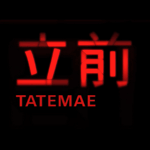

Are we so different from the Japanese? After moving to San Francisco from Chicago 17 years ago, I became fascinated with Asian culture. I took Japanese Language and Culture college classes. I became an anime fanatic (see otaku later in this article). I find the Japanese culture to be very different from ours. I think we can learn some things about ourselves by studying these differences. One major difference is the importance they place on the concept of wa, a perfectly harmonious group situation.
With Japan’s dense population, their main concern is to have harmony in order for society as a whole to function well. To avoid conflict, the Japanese compartmentalize two aspects of a person’s life: the first is Tatemae, which means “façade,” and the second is Honne, which refers to a person’s real beliefs and desires. Tatemae is the behavior a person displays in public and Honne is how a person acts behind closed doors. It is the concept of social harmony versus personal reality. Most Japanese people only show their Honne to those whom they truly trust. To understand this divide is to understand the Japanese psyche.
It is a complex dance of behavior; here are a couple of examples: in Japan, workers get paid time off, but they rarely use it because they think that their bosses will look down on them if they use it. On the other hand, it is also said that bosses in Japan offer the paid time off but don’t expect the workers to take it. I don’t know many Americans with that particular philosophy. The attitude I’m used to: Use it, don’t lose it!
Because the inner world is the only place where Japanese people can truly be themselves, a lot of tension and mental anxiety caused by Tatemae needs to be released at regular intervals. Another example of this complex behavior is called nomikai, which refers to the after-work social gatherings of co-workers in which lots of eating and drinking take place. It is customary for them to get drunk and let their Honne out. Their behavior is not discussed the next day at work. An otaku is someone who is passionately obsessed with an interest which is usually anime (Japanese animation), manga (Japanese comic books) or games. This behavior is accepted by their society. And many forms of extreme Japanese entertainment are accepted including porn, addiction to games and adult entertainment clubs.
The mask of Tatemae is difficult to maintain. Sometimes the masks crumble. One example of this in Japanese society is the emergence of the Hikikomori, which literally means “pulled inward, being confined.” The Hikikomori spend nearly every day confined to home and they avoid social situations. This condition lasts at least six months and can last as long as several years. This condition is not caused by any other medical or social cause than not being able to deal with the Tatemae/Honne divide. This social withdrawal happens over time. There are over 3.6 million people in Japan diagnosed as being part of the Hikikomori. Do you know any Hikikomori here in the United States?
Another example is the large number of “parasite singles.” They counted 10 million of these parasites in 1995. They are people in their 20’s and 30’s who live with their parents rather than live on their own. Most of them don’t pay any expenses and enjoy their parents doing all the chores for them. Professor Masahiro Yamada created the term in 1999 in his book The Age of Parasite Singles. Some attribute this to the fact that Japanese companies have not become flexible in the wake of the new economic reality and young adults are only able to find part-time work in many cases. Some see them as having a weak sense of self-reliance. Some see the parents as the culprits for this phenomenon. There are also “parasite couples” who live with one of the spouse’s parents.
My question is: How much of this do we have going on in American society? We don’t use those names: Tatemae and Honne, but do we engage in the behavior? In Japan, they value a life with no public conflict; they look to the well-being of society before the well-being of the individual. The result is that Japanese people have to sacrifice the ability to express their true feelings much of the time. In the remaining time, their society also seems to be tolerant of extreme Honne behavior.
In the United States, the political system seems to encourage a variety of ideas and, inevitably, conflict. Americans have the individual choice as to how they want to behave in public. It is an individual choice whether one wants to “play nice” in society and whether one feels that it is right to sacrifice the expression of one’s true thoughts and beliefs for the good of the group. In Japan, individuals also have a right to make that choice, but when they choose not to deal with Tatemae, there are not many options left. They sometimes end up as Hikikomori.
I do think that some Americans do choose to avoid conflict and they behave similarly to the Japanese. Others thrive off of causing conflict in every situation they encounter. Most of us fall in between the two extremes. American society does not value wa more than individual freedom. The trade-off is that American society is much less tolerant of extreme Honne behaviors than Japanese society. I think our society may be moving in the Japanese direction, though, especially in Americans’ attitudes about smoking and obesity.
To understand Japanese culture is to better understand American culture in comparison. Even though the concept of Tatemae/Honne can seem rather disingenuous, if it were practiced in the United States, it would possibly increase civility and lower crime. Japan has a much lower crime rate than the United States, driven by two main factors: very strict gun control laws and Tatemae/Honne.
About Cynthia Zeiden
Cynthia Zeiden is the National Program Chair and a National Trustee on the National Academy of Television Arts and Sciences Trustee Board. In her work for the NATAS San Francisco/Nor Cal Chapter, she produces media seminars, webcasts them and archives them into a professional development library. Her company, Zeiden Media, develops, produces, distributes and markets video content internationally. She was the Program Manager at KCSM-TV in San Mateo, CA and Director of Broadcast Operations at WYCC-TV in Chicago, both PBS stations. Cynthia is a three-time Chicago/Midwest Emmy®-nominated producer. She has a Master’s degree in Broadcast Management from The University of Tennessee.