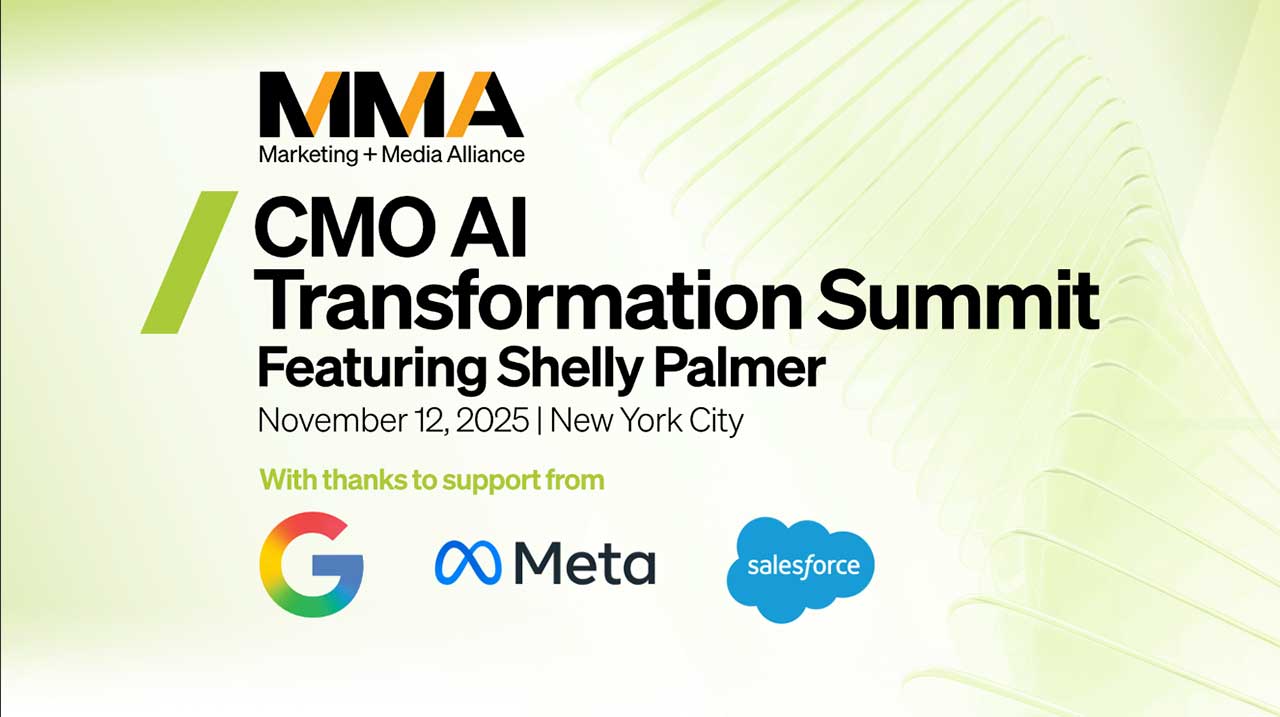
Agenda
- 12:00 PM · LUNCH
- 12:45 PM · Welcome
Greg Stuart with Google Representative - 12:50 PM · KEYNOTE: The Race to AGI
Shelly Palmer – The customer journey is over. AI now makes purchase decisions, search has become zero-click, and new toll booths appear at every digital touchpoint. Explore how leading brands navigate agentic commerce and what CMOs must do now. - 1:20 PM · Plenary Discussion
Full group moderated discussion - 1:30 PM · Navigating Agentic AI: Brand Implications
Simon Whitcombe (Meta) – How evolving AI capabilities impact the web, app, and search ecosystem. Critical implications for brands and actionable principles for adapting to agentic evolution. - 1:40 PM · Plenary Discussion
Full group moderated discussion - 1:55 PM · FIRESIDE CHAT: From Vision to Velocity
Jessica Murphy (Hasbro) with Shelly Palmer – Leading AI transformation inside a global brand. Cultural, organizational, and leadership challenges of turning ambition into action. - 2:05 PM · Plenary Discussion
Full group moderated discussion - 2:20 PM · The AI-Powered CMO
Martin Kihn (Salesforce) – How AI redefines growth, brand influence, and the balance between human creativity and AI amplification. Real-world use cases from Salesforce marketing. - 2:30 PM · Plenary Discussion
Full group moderated discussion - 2:45 PM · NETWORKING BREAK
- 3:00 PM · BREAKOUT SESSIONS – Download the discussion guide here.
- Group 1: Agentic Consumer Bots
Consumer AI agents make purchasing decisions without human intervention. Marketing teams must adapt strategies, pricing models, and brand positioning when the customer is a bot making decisions based on structured data instead of emotional appeals. - Group 2: Answer Engine Optimization
Search engines are becoming answer engines. Users receive direct answers synthesized from multiple sources. Marketing teams must structure content so AI systems can parse, attribute, and cite it in generated responses. - Group 3: Identity Threat
Marketing teams train AI to perform tasks requiring human judgment. Address the tension between adopting AI to remain competitive and the fear that adoption accelerates obsolescence.
- Group 1: Agentic Consumer Bots
- 3:30 PM · Breakout Session Summaries
5-minute summaries from each of the three breakout groups - 3:50 PM · Future of Marketing in the Agentic Era
Tarun Rathnam (Google) – Agentic AI moves from content creation to systems that autonomously drive business outcomes. A CMO playbook for transformation across process, platform, and people. - 4:00 PM · Plenary Discussion
Full group moderated discussion - 4:15 PM · AI and Retail Media
Jay Altschuler (Mastercard) with Shelly Palmer – Agentic planning and buying, internal process challenges of adopting AI-driven approaches at scale, and the broader media landscape. - 4:25 PM · Plenary Discussion
Full group moderated discussion - 4:40 PM · CLOSING KEYNOTE: Rebuilding for the Future
Norm de Greve (GM Chief Growth Officer) with Shelly Palmer – How GM transformed marketing with AI. Rebuilt marketing system for speed, creativity, and accountability while taking nearly a billion dollars out of spend. How AI reshapes creativity and how leadership turns technology into growth. - 4:55 PM · Closing Remarks
Shelly Palmer and Greg Stuart - 5:00 PM · COCKTAIL HOUR
AI Glossary for Today’s Meeting
AI isn’t hard to understand. It’s hard to talk about clearly. The technology moves faster than the language used to describe it, which leads to misalignment and wasted time. Every effective AI meeting starts with a shared vocabulary.
Use this glossary to make sure your team is literally on the same page before making decisions that shape strategy, governance, and execution. You can download a printable PDF here.
Core Concepts
Artificial Intelligence (AI) – Computer systems that perform tasks that typically require human intelligence, such as understanding language, recognizing patterns, making predictions, or solving problems.
Machine Learning (ML) – Methods that learn patterns from data and improve performance without being explicitly programmed for each outcome.
Generative AI – Models that create new content such as text, images, audio, or code rather than only analyzing existing data.
Large Language Models (LLMs) – Models trained on massive text datasets that can understand and generate human-like language. Most chatbots and text-based assistants use LLMs.
Reasoning Engines – AI systems designed to analyze information, apply logic, and produce explainable conclusions. Capabilities vary by model and vendor.
Diffusion Models – Generative models that create realistic images, video, or audio by gradually transforming random noise into coherent outputs.
Artificial General Intelligence (AGI) – A hypothetical level of AI that could perform any intellectual task a human can. No system today meets this standard.
Artificial Superintelligence (ASI) – A theoretical form of AI that would exceed human intelligence in all areas. ASI remains speculative.
Foundational Model Builders – The companies that design and train large-scale models used across industries, including OpenAI, Google DeepMind, Anthropic, Mistral, and Meta.
Hyperscalers – Global cloud infrastructure providers like Amazon Web Services, Microsoft Azure, and Google Cloud that supply the compute power required to train and deploy advanced AI systems.
Agents and Agentic Systems
Agents – Independent AI programs that perform specific tasks such as summarizing emails, generating reports, or scheduling meetings.
Agentic Systems – Connected groups of AI agents that collaborate to complete multi-step workflows under human oversight and governance.
Model Context Protocol (MCP) – An open standard that enables AI agents and applications to communicate, authenticate, and securely share information across tools and environments. (modelcontextprotocol.io)
AdCP (Ad Context Protocol) – An emerging standard that defines how AI agents, advertisers, and publishers exchange information during automated ad transactions. It aims to improve speed, transparency, and auditability.
ACP (Agentic Commerce Protocol) – An emerging standard that defines how AI agents negotiate, purchase, and complete transactions under defined business rules, enabling secure, auditable machine-to-machine commerce.
ACO (Agentic Commerce Optimization) – A strategy for preparing product catalogs, feeds, checkout systems and metadata so that AI shopping agents not only discover your offerings but also transact on your behalf. Mastering ACO means shifting from human-click conversion to being selected by machines.
Connecting AI Systems
API (Application Programming Interface) – A set of rules that allows one software system to interact with another. APIs enable AI tools to access CRMs, ERPs, or other enterprise systems.
Retrieval-Augmented Generation (RAG) – A technique that retrieves trusted information at query time to improve the accuracy and reliability of AI-generated responses.
Context Window – The amount of information an AI model can process at once. Larger windows allow longer and more complex instructions.
Knowledge Graph – A structured database of entities and relationships that allows AI systems to reason, infer, and personalize results.
Vector Database – A database optimized for storing data as vector embeddings, enabling AI systems to retrieve information by meaning rather than by keyword match.
Data Fabric – An integrated data layer that connects disparate sources, ensuring AI systems can find, access, and use information consistently across an organization.
Developing and Adapting AI
Fine-Tuning – The process of retraining a pre-trained model on specialized data to improve its performance on a defined task or within a domain.
Low-Code AI – Platforms that let developers or analysts build AI workflows with minimal hand-written code.
No-Code AI – Visual tools that allow non-technical users to build AI applications through drag-and-drop interfaces. Useful for prototypes and internal tools.
Synthetic Data – Artificially generated data used to train or test models when real data is limited, sensitive, or unavailable. Helps reduce privacy risks and improve balance in datasets.
Evaluation Dataset – A controlled dataset used to measure model performance, reliability, and bias before deployment.
Prompting and Context Design
Prompt Engineering (Prompt Crafting) – Writing precise and structured instructions that guide AI systems to deliver relevant, accurate, and consistent outputs.
Pre-Prompt – The hidden or system-level instructions that shape an AI’s behavior before any user input is processed.
Meta Prompt – A higher-level directive that governs how an AI interprets and responds to all subsequent prompts in a workflow or session.
JSON Context Profile – A structured file that defines roles, tone, audience, and behavioral rules for an AI system to maintain consistent responses across sessions and agents.
Prompt Orchestration – The coordination of multiple prompts or models to complete a multi-step task with repeatability and auditability.
Context Engineering – Structuring information so AI systems understand what matters before generating outputs, improving accuracy and business alignment.
Creative and Human-Language Interfaces
Vibe Coding / Vibe Marketing / Vibe Prompts – Specifying tone, mood, or style in plain language and allowing AI to generate content that fits that description.
AEO (Answer Engine Optimization, also called Generative Engine Optimization or GEO) – Structuring digital content so AI assistants and search engines can understand, cite, and present it accurately. This includes using JSON-LD (JavaScript Object Notation for Linked Data) – a W3C standard for embedding structured, machine-readable data into web pages so AI systems can correctly interpret brand, product, and factual information.
Governance and Measurement
Guardrails (Governance Layer) – The policies, controls, and monitoring systems that govern how AI is deployed, maintained, and audited inside an organization.
AI Policy – The documented guidelines that define responsible AI use across an organization, including ethics, data protection, and compliance requirements.
Model Card – A standardized document describing a model’s purpose, training data, limitations, and performance metrics. Used for transparency and accountability.
Audit Trail – A secure, immutable record of who interacted with an AI system, when, and how. Essential for governance and compliance.
Evals – Metrics used to evaluate model performance, including accuracy, robustness, safety, latency, and cost efficiency.
Information and Research Tools
Deep Research Tools – AI applications that search, summarize, and synthesize information from multiple trusted sources. Examples include Perplexity, NotebookLM, and ChatGPT with browsing.
These Terms Will Continue to Evolve
AI terminology changes quickly. Aligning on definitions before strategic discussions improves clarity, decisions, and results.